Inside Korea's hyper-connected economy & ecosystem. IT Park Uzbekistan Delegation Visits GDIN to Forge Tech Ecosystem Partnership |
|
|
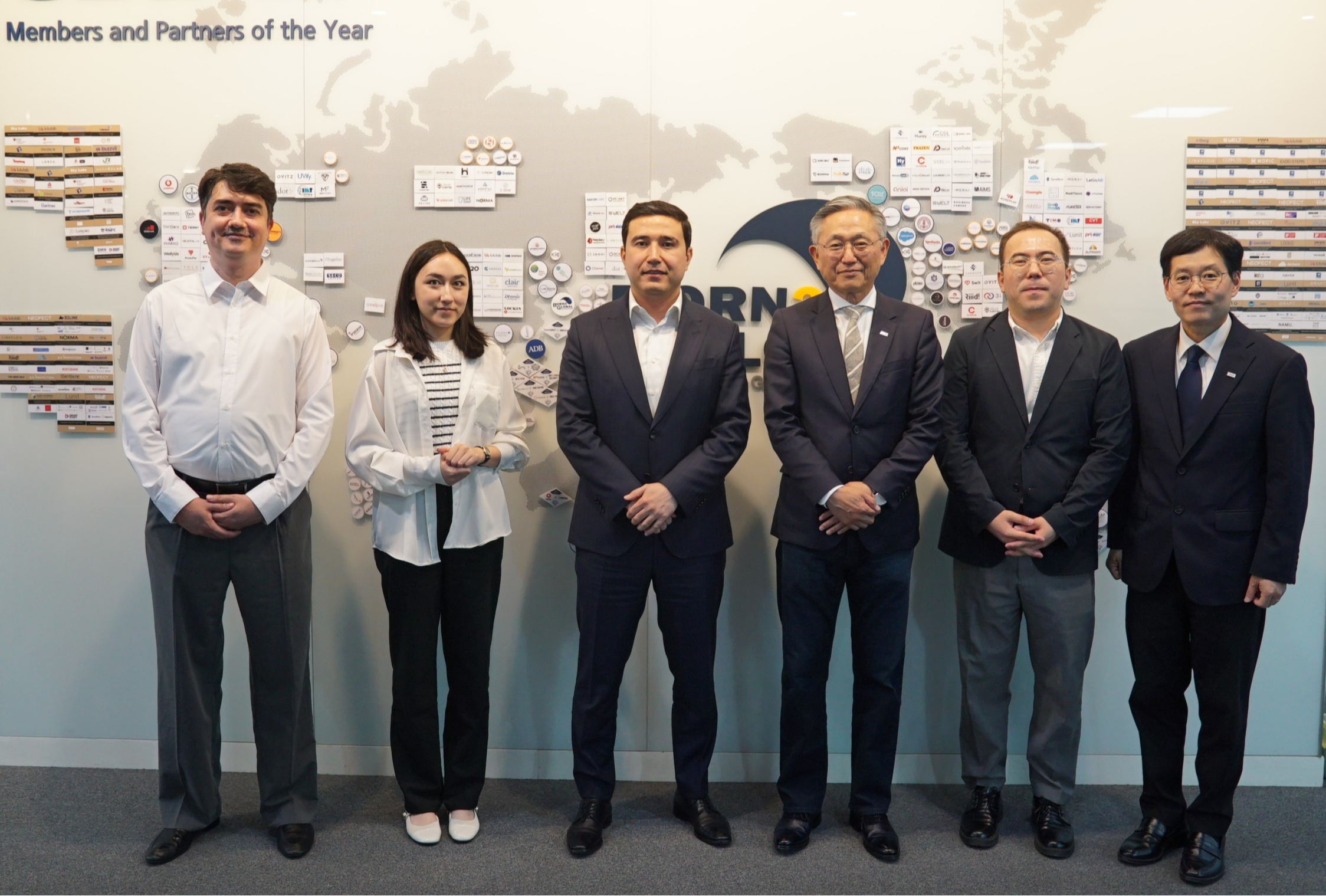
A high-level delegation from IT Park Uzbekistan visited GDIN at the Pangyo Techno Valley to discuss cross-border tech exchanges and market validation opportunities. Led by CEO Azamat Karamatov, along with Umida Odilova (Head of AI & R&D Division) and Nodirbek Berdikobilov (Head of Global Growth, Eastern Markets), the meeting focused on establishing bilateral scaling frameworks for deep-tech startups. Operating under the Ministry of Digital Technologies of Uzbekistan, IT Park is the nation’s premier infrastructure driver tasked with accelerating the venture ecosystem and facilitating international business expansion.
🇺🇿 Introducing Global PoC and Joint Venture Frameworks
During the institutional briefing, Sokjin Chang, Managing Director at GDIN, introduced South Korea’s startup infrastructure in Pangyo, sharing GDIN’s standard global acceleration frameworks. He heavily highlighted GDIN's documented success in executing "Global PoC" and "Global Joint Venture Establishment Support Programs" driven in partnership with multilateral development banks (MDBs). Rather than pursuing simple overseas outbound exports, GDIN proposed a mutual growth model centered on active technology transfer and localization through domestic-foreign corporate partnerships, drawing strong consensus from the Uzbek leaders.
🏢 A One-Stop Bridgehead for Korean Tech Entering Central Asia
Impressed by Korea's dynamic tech cluster, IT Park CEO Azamat Karamatov emphasized Uzbekistan's readiness to serve as a strategic launchpad for Korean tech companies looking to penetrate the broader Central Asian market. He outlined IT Park's robust local infrastructure, which offers foreign technology companies entering the region specialized one-stop services, including premium workspace provisioning and comprehensive tax incentives. Expressing a strong intent to build a sustainable, actionable partnership with GDIN, the delegation welcomed follow-on corporate matches.
💡 Strategic Alignment: Prioritizing Capital Access and Joint Business Pilots
To transform institutional dialogue into commercial reality, GDIN CEO Jongkap Kim proposed a forward-looking cooperative roadmap centered on market liquidity and revenue generation:
-
The Core Premise: Kim noted that the absolute bottleneck for early-stage startup scale-up and commercialization is "access to capital," which includes direct venture funding and immediate revenue-generating pipelines.
-
Bilateral Project Mobilization: Instead of superficial networking, GDIN proposed co-identifying and structuring concrete commercial projects on the ground in Central Asia. Under this framework, elite tech startups from both South Korea and Uzbekistan will form cross-border partnerships to actively co-execute these government and corporate-driven digital projects.
Central Asia is rapidly emerging as a high-growth sandbox, propelled by a young demographic profile and aggressive government-led digital transformation initiatives. Following this institutional milestone, GDIN will continue to establish risk-mitigated gateways for Korean deep-tech innovators to deploy solutions seamlessly in emerging Central Asian corridors.
|
|
|
🚀 DeepX: The artificial intelligence semiconductor pioneer signed a three-year global mass-production cooperation contract with AAEON, the industrial computing subsidiary of Taiwan’s ASUS Group. Under this agreement, DeepX’s high-performance NPU-based AI solutions will be directly integrated into AAEON's flagship product lineups, including industrial and single-board computers and edge gateways, to accelerate global edge-AI adoption.
|
|
|
🚀 SSenStone: The authentication and security specialist secured a strategic investment from Hyundai Motor Group. Driven by its proprietary One-Time Authentication Code (OTAC) TAG technology, SSenStone leads the Operational Technology (OT) security sector by dramatically reinforcing manufacturing-floor access control and authentication without requiring any structural modifications or setup overhauls to legacy enterprise infrastructure. |
|
|
🚀 Kzone: The global reverse logistics platform innovator successfully completed a KRW 6.3 billion (approx. USD 4.2 million) Series B funding round. Through 'REMEX,' its proprietary platform that leverages data analytics to optimize product returns and excess inventory, Kzone achieved net profitability and an annual revenue of KRW 12 billion (approx. USD 8.0 million) within just three years of market entry, validating its dominance in the cross-border logistics sector. |
|
|
🚀 Ditonic: The spatio-temporal AI platform specialist signed a Memorandum of Understanding (MOU) with LIG Defense & Aerospace to co-develop defense-specialized AI platforms. Through this strategic alignment, Ditonic’s high-performance geo-spatial big data engine, 'D.Hub,' will be integrated as the core processing engine into 'L-NODE,' LIG’s next-generation defense platform that fuses ontology knowledge systems with agentic AI architecture. |
|
|
Generative Blueprints: Redefining Architectural Feasibility with Generative AI |
|
|
When developing raw land or launching a massive real estate project, one of the most unpredictable and friction-heavy segments resides within the initial feasibility study and design phase. Architects and developers historically spend months iterating blueprints to balance strict local zoning laws against targeted financial returns.
However, generative AI is actively digitizing this sector. A prominent global indicator of this shift is Paris-based proptech startup Davis AI, which recently secured $5.5 million in pre-seed funding. Alongside the capital injection, Davis AI unveiled 'Gaudi-1,' its proprietary foundation model that leverages Discrete Diffusion technology to structurally assemble architectural elements—delivering professional-grade 3D layouts and feasibility reports within hours rather than months.
🇰🇷 Zenerate: Quantifying Real Estate Feasibility Through Algorithmic Automation While European platforms gain momentum, South Korean generative proptech pioneer Zenerate is scaling a powerful web-based design automation engine engineered to institutionalize real estate development and maximize risk-adjusted returns.
⚡ From Months to One Minute: Zero-Friction Layout Generation Zenerate completely automates the early-stage site-planning pipeline, enabling developers and architectural firms to compress months of guesswork into a fraction of a second. By simply inputting raw land parcels alongside specific localized targets—such as floor area ratios (FAR), building coverage restrictions, and target unit counts—Zenerate’s algorithmic engine generates optimal 3D building massing options and neighborhood site configurations in under 60 seconds.
📈 Live-Linked Financial Engineering and Executive-Grade Proformas
Unlike standard 3D modeling programs that focus strictly on visualization, Zenerate bridges the gap between spatial geometry and financial viability:
-
Real-Time Financial Simulations: As the AI moves structural assets on the digital canvas, it simultaneously calculates critical investment metrics, including Net Operating Income (NOI), total projected hard costs, estimated construction expenditures, and overall Return on Investment (ROI).
-
Automated Institutional Reports: The platform instantly synthesizes all computational variables into an executive-grade, customized feasibility report. This asset bundle includes precise site layouts, optimized test fits, proforma financial models, granular cost estimations, and hyper-realistic 3D renderings optimized for immediate investor presentations.
Architecture and property development have long remained locked behind manual intuition and slow-moving design loops. By converting spatial planning into a discipline governed by quantitative data and generative algorithms, pioneers like Zenerate are giving global developers the ultimate tool to de-risk high-stakes investments long before breaking ground.
|
|
|
Decoding Korean Innovation |
|
|
Korea’s Digital Platform Market Hits KRW 500 Trillion |
|
|
South Korea’s digital economy has crossed a monumental threshold, cementing its status as one of the world's most densely digitalized markets. According to the 2025 Value-Added Telecommunications Business Survey released by the Ministry of Science and ICT (MSIT) on June 3, the total revenue of Korea’s value-added telecom sector reached an estimated KRW 502.9 trillion (approx. USD 335.3 billion), marking a powerful 15.3% year-on-year surge. Within this macro-landscape, the digital platform market alone accounted for KRW 161.5 trillion (approx. USD 107.7 billion), representing 32.1% of the entire sector.
📊 The "Everyday Infrastructure" and Sovereign Hegemony
The empirical data confirms that digital platforms in Korea have completely transitioned from optional utilities into essential daily infrastructure, exhibiting massive user stickiness:
-
Ubiquitous Penetration: Among Korean adults aged 19–69, general search engine usage stands at 98.7%, mobile messaging at 98.5%, digital mapping/navigation at 96.8%, and e-commerce at 95.6%.
-
Daily Engagement: Mobile messengers lead daily engagement metrics at 91.3%, followed closely by search portals at 85.8% and video-sharing platforms at 69.5%.
-
Sovereign Platform Dominance: In sharp contrast to global markets dominated entirely by Silicon Valley Big Tech, Korea maintains strong digital sovereignty. Domestic pioneers command the market, led by KakaoTalk in messaging (92.5%), Naver in general search (67.5%), Coupang in e-commerce (53.6%), and Daangn in hyper-local secondhand trade (88.3%).
⚙️ The Generative AI Disruption and the Multi-Homing Lock-In Battle
While local heavyweights protect their traditional domains, the report highlights an aggressive paradigm shift driven by Generative AI and sophisticated subscription bundle warfare:
-
Rapid GenAI Adoption: OpenAI's ChatGPT has captured the dominant 1st-place position in the generative AI category with a 68.1% primary utilization rate. Impressively, 60% of GenAI users state that AI has already replaced more than half of their traditional search engine behaviors, with adoption among users in their 20s reaching a staggering 92.6%.
-
The "Multi-Homing" Fluidity: Korean consumers are highly strategic, demonstrating active "multi-homing" behaviors (simultaneously utilizing multiple platforms) in e-commerce (83.9%) and social media (79.9%) to compare optimal pricing and distinct content.
-
Hyper-Bundling as a Defensive Shield: To combat this multi-homing fluidity, major platforms are executing aggressive premium bundling strategies to increase user lock-in. E-commerce paid membership penetration has reached 75.9%. Coupang leverages its "Wow Membership" by bundling rapid logistics with food delivery discounts (Coupang Eats), while Naver counters by fusing its price-comparison ecosystem with premium OTT entertainment (Netflix) integrations.
For global tech innovators, operators, and cross-border investors, the MSIT data signals that South Korea represents a hyper-matured, fast-adapting digital sandbox. It is an environment where infrastructure penetration has maxed out, and the next frontier of growth is being fiercely contested through advanced AI integration and multi-layered ecosystem locking mechanisms.
|
|
|
Was this newsletter forwarded to you? Don't miss out on the next pulse of Korean innovation. Sign up here to get your own copy every week. |
|
|
4F, Startup Campus Building #3, 20, Pangyo-ro 289, Bundang, Seongnam, Korea 13488
You are receiving this email because you have visited our site or asked us about regular newsletter.
|
|
|
|
|