Joomidang digitizes flavor; Korea plans mass AX push Shandong Provincial and Weihai Municipal Delegation Visits GDIN |
|
|
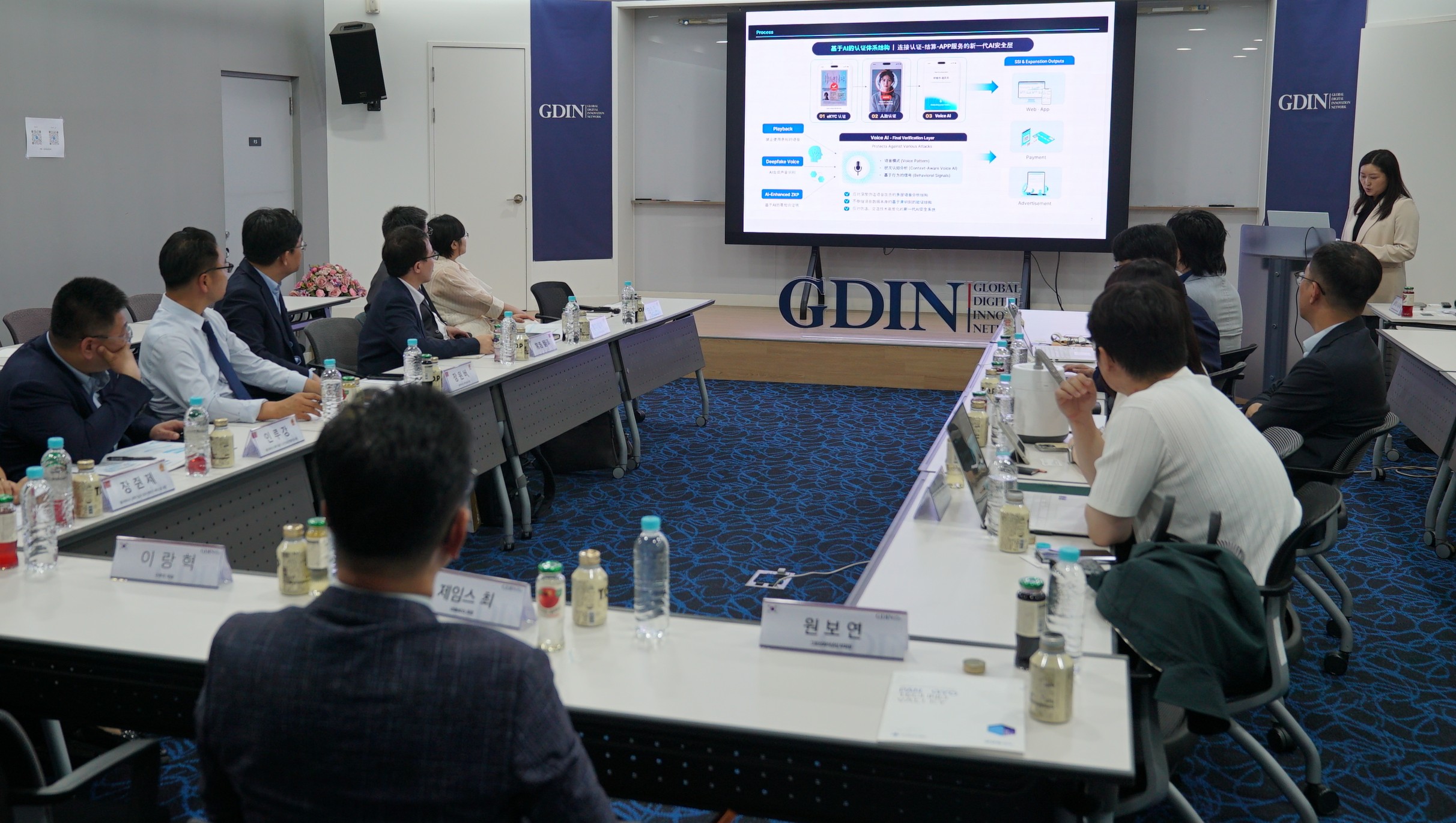
GDIN welcomed a government delegation from China’s Shandong Province and Weihai City to the Pangyo Techno Valley to discuss regional tech exchanges and market validation opportunities. Led by Zhang Yunbo, Director of the Weihai Municipal Science and Technology Bureau, the meeting focused on understanding the digital startup ecosystems of both regions.
🇨🇳 Ecosystem Briefing and Regional Infrastructure Overview
During the institutional meeting, Tay Lee, Director of Business Team at GDIN, introduced South Korea’s startup infrastructure in Pangyo, sharing GDIN’s standard global acceleration frameworks and Joint Venture (JV) establishment support models. In return, the Shandong delegation outlined Weihai City’s industrial infrastructure and current local enterprise support policies available for foreign technology companies entering the region.
🚀 IR Session: Korean Startups Present Solutions for Local Markets
The visit included an IR session where four Korean tech startups presented their business models and discussed potential local market adaptability in China:
-
Crosshub: Presented 'V-Pay,' a fintech infrastructure solution that combines blockchain and AI-based biometric (voice and facial) authentication, designed to process cross-border transactions for global users independent of legacy system constraints.
-
Vivacity: Introduced 'diimsum,' an AI-driven, subscription-based SaaS that aggregates and analyzes user feedback across global gaming community channels (such as QQ and Discord) to assist publishers with operational efficiency.
-
Rhinocare Korea: Demonstrated 'RhinoCare®,' a non-pharmaceutical home healthcare device that uses jet-stream technology to deliver 43°C thermal saturated steam into the nasal cavity, targeting demand in the regional respiratory care market.
-
Promlabs: Presented 'CREUS AI,' a content operating system (OS) that centralizes the AI content creation workflow—including production, review, and approval—into a single dashboard, proposing a bilateral content exchange pilot (PoC) with local firms in Weihai.
Following the presentations, the Chinese delegation engaged in a Q&A session to discuss practical aspects of the solutions, focusing on local market viability, technical integration, and relevant regulatory requirements. GDIN will continue to maintain dialogue with various international partners to help Korean deep-tech companies explore practical pathways into global markets.
|
|
|
🚀 Pablo Air: Signed a Letter of Intent (LOI) with Canada’s defense enterprise, IMT, to co-develop and integrate next-generation autonomous systems powered by advanced Unmanned Aerial Vehicles (UAVs) and swarm intelligence technologies. Through this collaboration, both entities plan to accelerate their strategic entry into military drone markets across North America and NATO member nations.
🚀 EverEx: Honored with a prestigious Scientific Award at the European Society for Sports Traumatology, Knee Surgery and Arthroscopy (ESSKA) international congress for its musculoskeletal digital therapeutic device, 'MORA Cure.' The accolade recognizes the successful outcomes of its pivotal clinical trial targeting anterior knee pain patients, validating the clinical efficacy of digital therapeutics in musculoskeletal care.
🚀 Airs Medical: Secured a commercial deployment contract with Samsung Medical Center for its AI-powered MRI reconstruction solution, 'SwiftMR.' By utilizing deep learning algorithms to eliminate noise and enhance spatial resolution in accelerated MRI scans, the vendor-neutral software has already been deployed across 933 medical institutions in 51 countries worldwide.
🚀 FuriosaAI: Partnered with global semiconductor leader Broadcom to co-develop next-generation AI accelerators. The strategic initiative will integrate FuriosaAI's next-gen Neural Processing Unit (NPU) architecture with Broadcom’s ultra-high-speed AI networking and high-bandwidth Ethernet switch technologies to engineer a unified platform optimized for large-scale AI inference clusters.
|
|
|
The Digitalization of Senses: the Frontier of Scent and Flavor Tech |
|
|
While vision and hearing have fully migrated into the digital realm, the analog worlds of olfaction (smell) and gustation (taste) have historically remained locked behind human subjectivity. For decades, traditional fragrance houses and legacy breweries have relied entirely on the artisan's individual intuition and experience. However, a massive technological paradigm shift is underway. Scent-and-flavor tech or "Scent-tech" is emerging as a highly lucrative blue ocean. A notable global indicator is New York-based startup Patina, which recently raised a $2 million seed round by mapping human olfactory receptors to its proprietary foundation model, 'Sense1,' enabling small consumer brands to synthesize safe, climate-resilient custom fragrance molecules in weeks rather than years.
🇰🇷 Joomidang: Digitizing Flavor through Industrial AX
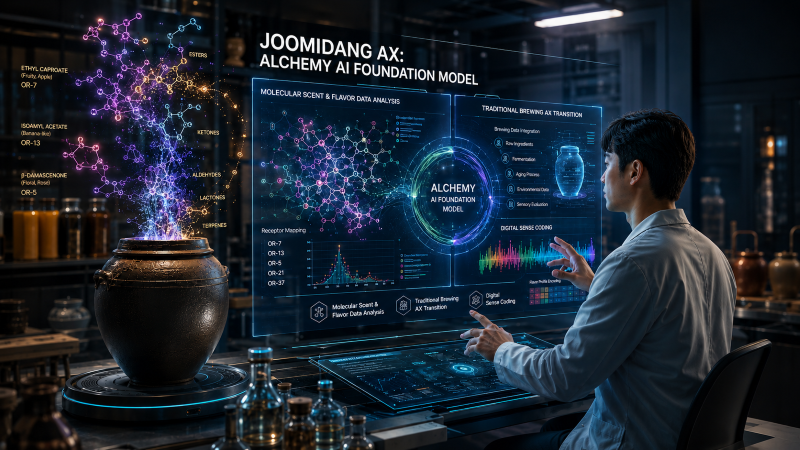
While Silicon Valley platforms focus on custom synthetic molecules, South Korean flavor-tech pioneer Joomidang is executing a market-ready industrial AI conversion targeting the multi-billion-dollar food, beverage, and cosmetics sectors.
-
From Months to One Minute: Developing a new commercial beverage or fragrance recipe typically requires months of trial-and-error chemical blending and repetitive sensory evaluations. Joomidang’s proprietary foundation AI, 'Alchemy,' eliminates this bottleneck. By inputting intuitive natural language prompts into a console—such as "A vibrant, sharp yuzu citrus profile wrapped in a subtle, sweet finish with 8% ABV"—Alchemy cross-references massive sensory interaction datasets and delivers a precise, manufacturing-ready recipe in under a minute.
-
Overcoming the "Human Fatigue" Barrier: Human sensory panels rapidly desensitize during prolonged taste and smell tests. Joomidang’s AI delivers mathematically consistent chemical blueprints, boosting production precision. Traditionally, the consistency rate between an initial flavor concept and the final manufactured product sits at just 35%. Joomidang raises this exact replica rate to a staggering 93%.
Joomidang's commercial viability is backed by explosive growth: annual revenue plummeted from KRW 190 million in 2023 to KRW 17 billion in 2025, driven by deploying Alchemy across local production lines. Backed by a recent KRW 5.5 billion (approx. USD 3.7 million) Pre-Series A funding round, the company is scaling its business model into global fragrance, beauty, and automated distillery markets.
|
|
|
Decoding Korean Innovation |
|
|
A Nation of Innovators: The Mass Mobilization of Tech in Korea |
|
|
The South Korean startup ecosystem is experiencing a massive democratic shift. According to the Ministry of SMEs and Startups (MSS), the newly launched national initiative, "Everyone’s Startup" project, attracted an unprecedented 62,944 applicants during its first cohort phase. This milestone marks the largest pool in the history of domestic government-led startup competitions.
📊 Sovereign AX Trend and Regional Decentralization Signals
An analysis of the cohort data reveals two prominent structural directions in the Korean tech landscape:
-
Sovereign AI Integration: Within the General and Deep-Tech track (51,907 applicants), 29.6% explicitly integrated AI frameworks. "AI" emerged as the primary keyword across 42.2% of the blueprints, validating that the AI Transformation has heavily penetrated early-stage Korean entrepreneurship.
-
Regional Diversification: Moving away from Seoul-centric centralization, non-Seoul applicants surged to 53.4% (33,628 founders). This significantly outperforms standard startup programs where regional representation typically hovers at around 30%.
⚙️ Structured Scale-up Pipeline: Infusing AI, Capital, and Regulatory Screening To convert this volume into viable corporate entities, the government is filtering applicants down to 5,000 elite innovators by mid-June through a multi-layered infrastructure pipeline:
-
AI & Compute Resources: Tech founders will be provisioned with direct access to 406 distinct AI enterprise solutions. Advanced AI startups will specifically receive a total of 30 GPUs to support high-performance model training.
-
Regulatory Screening: To prevent deep-tech solutions from stalling, the Startup One-Stop Support Center will deploy a legal task force to provide pre-emptive regulatory clearance before products enter commercial validation.
-
Financial Liquidity: A dedicated KRW 155 billion (approx. USD 104 million) fund has been co-established alongside five major tier-1 commercial banks to inject immediate financial backing.
In July, the government will launch its secondary phase, doubling the selection scale to 10,000 entrepreneurs. Crucially, this next phase will inaugurate the "Global League," expanding localized validation channels directly into Silicon Valley, Singapore, and India. For global co-investors, Korea is proving its capacity to institutionalize and de-risk early-stage deep-tech innovation at an industrial scale.
|
|
|
Was this newsletter forwarded to you? Don't miss out on the next pulse of Korean innovation. Sign up here to get your own copy every week. |
|
|
4F, Startup Campus Building #3, 20, Pangyo-ro 289, Bundang, Seongnam, Korea 13488
You are receiving this email because you have visited our site or asked us about regular newsletter.
|
|
|
|
|