IT Park Korea office, AfDB AI voucher & SKAI Intelligence Uzbekistan’s IT Park Opens Korea Office at GDIN to Drive Bilateral AI Synergies |
|
|
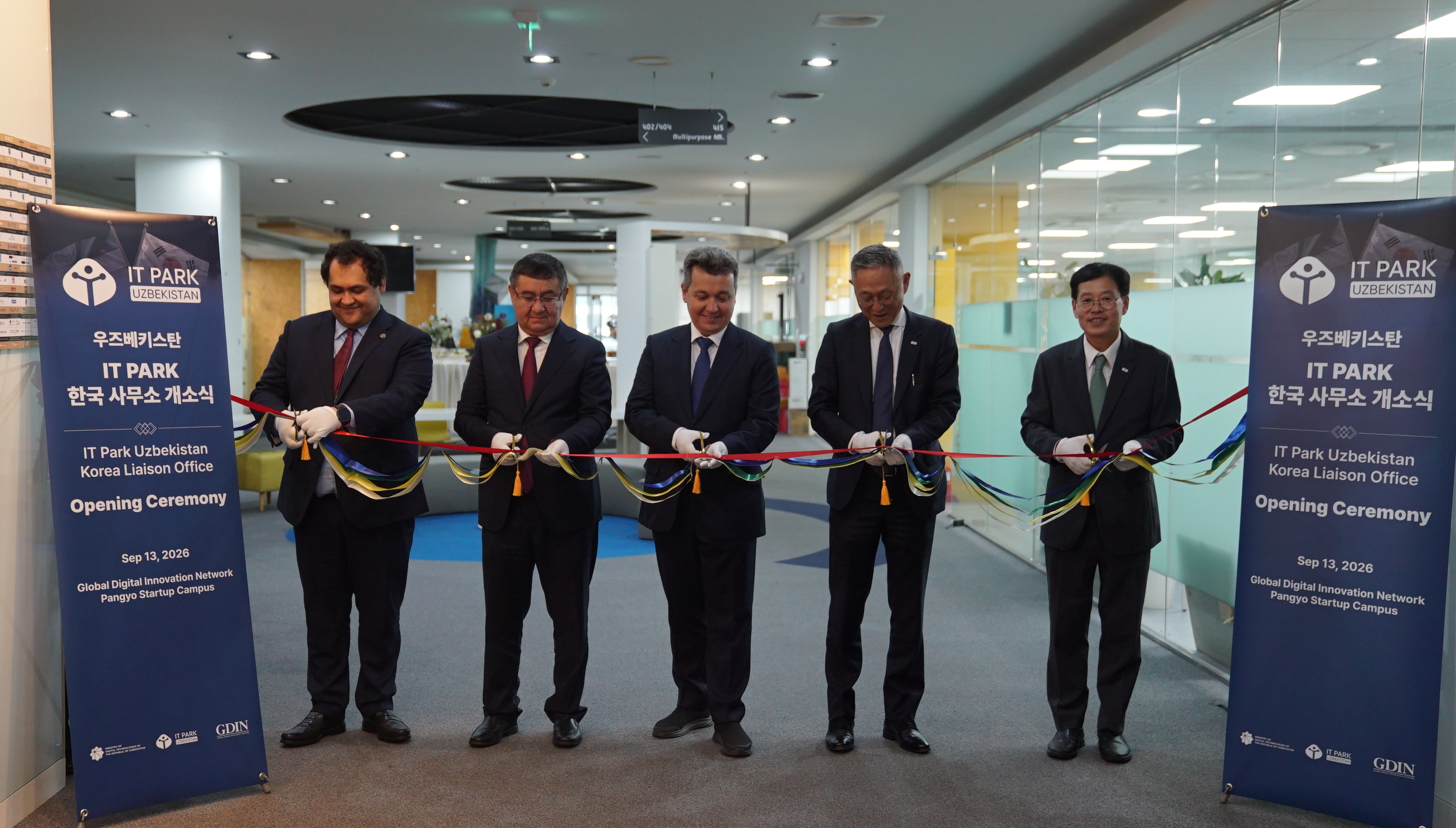
On September 13, GDIN hosted the official opening ceremony for Uzbekistan’s IT Park Korea Office at the Pangyo Startup Campus. Achieved in just three months following an initial delegation visit in June, this milestone establishes a permanent operational bridge to accelerate cross-border tech joint ventures (JVs), IT talent exchange, and digital transformation (DX) initiatives between South Korea and Central Asia.
🤝 Pangyo Base to Catalyze 'Digital Uzbekistan - 2030'
Attending the ceremony in person, Sherzod Shermatov, Uzbekistan's Minister of Digital Technologies, highlighted that setting up an office in Korea’s Silicon Valley will serve as a vital two-way bridge for Korean tech firms expanding into Central Asia and Uzbek enterprises securing global partners. Driven by Minister Shermatov, the national 'Digital Uzbekistan - 2030' strategy aims to build a $1.5 billion AI market and reach $5 billion in IT service exports. Led by Representative Daniyar Atadjanov, the new Pangyo office will directly manage bilateral business matching and market alignment.
📋 Strategic MoU for Joint Investment and Talent Mobility
During the ceremony, GDIN and IT Park executed a comprehensive MoU focused on AI and DX co-innovation. Key execution pillars include:
-
Cross-Border JVs & Expansion: Facilitating market access and commercial localization for promising enterprises in both regions.
-
Joint Scale-Up Investment: Establishing a co-investment mechanism to finance high-growth tech startups.
-
Open Innovation & Talent Exchange: Executing joint projects to resolve regional tech challenges while tapping into Uzbekistan's skilled IT talent pool.
-
Knowledge Exchange: Running specialized knowledge-sharing programs focused on digital tech adoption and VC investment dynamics.
Highlighting the vision, GDIN CEO JongKap Kim emphasized that synthesizing Korea's deep-tech capabilities with Uzbekistan's IT engineering talent will create high-impact JVs capable of scaling across global markets.
|
|
|
GDIN Launches 'Korea-Africa K-AI Voucher Project' at KOAFEC with AfDB |
|
|
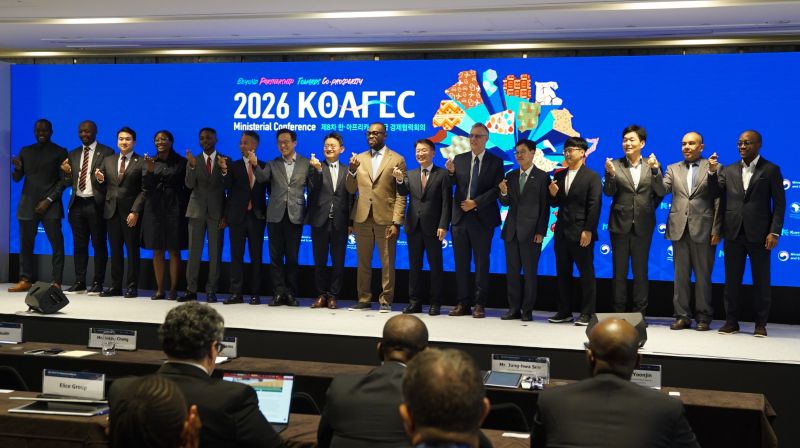
On September 9, GDIN, in strategic partnership with the African Development Bank (AfDB), officially launched the 'Korea-Africa K-AI Voucher Project' at the 2026 Korea-Africa Economic Cooperation (KOAFEC) Ministerial Conference in Seoul. This cross-border initiative is designed to resolve the critical computing infrastructure bottlenecks faced by early-stage African AI startups, while facilitating robust commercial synergies between Korean tech innovators and the emerging African digital ecosystem.
Highlighting the project's strategic gravity, the launch ceremony featured welcoming remarks from key institutional leaders shaping this initiative, including Dr. Bosun Tijani, Nigeria's Minister of Communications, Innovation and Digital Economy; Yoonjin Kang, Director General at the Ministry of Finance and Economy (MOFE); and Jung-hwa Seo, Executive Director of the EDCF Operation Group at Korea Eximbank.
🚀 Bridging AI Infrastructure and JV Incubation
Under the initial six-month pilot framework, participating African AI startups will receive subsidized high-performance computing credits, cloud platform access, and dedicated technical support provided by partnering Korean tech enterprises. Furthermore, GDIN will leverage its proprietary Joint Venture incubation program to facilitate strategic tech matchmaking, empowering Korean innovators to seamlessly expand into one of the world's fastest-growing digital markets.
💡 AI Use Case Pitches & Strategic MoUs
The event featured a dynamic pitch session spanning AI e-health, advanced cloud infrastructure, GPU-accelerated solutions, B2B platforms, and RegTech. The stage showcased African innovators—Kera Health Platforms, Amini AI, UduTech, BLOK TECHNOLOGY, Danaya, and MStudio—alongside Korean tech leaders Elice Group, Health on Cloud, DSRV, and BARO AI.
Following the pitches, the session culminated in the execution of five strategic Memorandums of Understanding (MoUs):
Moving forward, GDIN will utilize this pilot initiative as a foundational benchmark to establish a sustainable Korea-Africa digital partnership, continuously turning cross-border AI potential into mutual prosperity.
|
|
|
GDIN Inks Strategic DX Partnership with Uzbekistan’s TUIT |
|
|
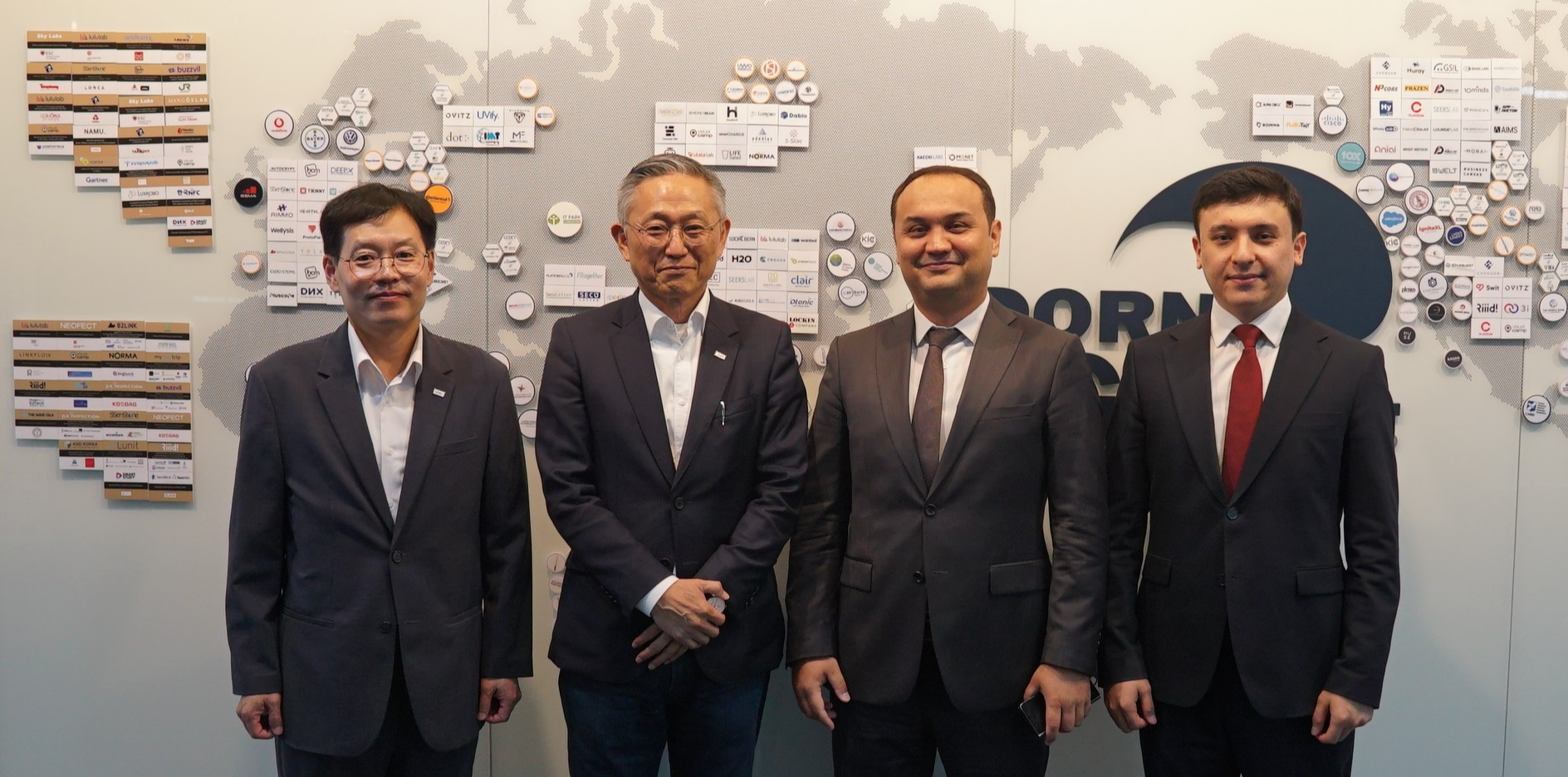
On September 11, GDIN executed a Memorandum of Understanding (MoU) on digital transformation and technology cooperation with the Tashkent University of Information Technologies (TUIT), Uzbekistan's premier national IT institution. The agreement, signed during a visit to GDIN by a TUIT delegation led by Rector Bakhtiyor Makhkamov, establishes a robust framework for cross-border DX collaboration and global IT talent acquisition.
🤝 Fusing Korean Advanced Tech with Central Asia's IT Talent Pipeline
During the bilateral discussions preceding the signing, Rector Makhkamov highlighted TUIT's role as the core talent incubation hub under Uzbekistan’s Ministry of Digital Technologies, boasting advanced educational infrastructure across critical frontiers such as AI, cybersecurity, and robotics. In response, CEO Jongkap Kim emphasized that synthesizing Korea's advanced tech capabilities with Uzbekistan's highly skilled engineering talent pool will generate powerful commercial synergies, empowering joint ventures to scale not only in Central Asia but across broader global markets.
📋 Actionable Framework for Commercial Scaling
Moving beyond conventional academic exchange, the MoU outlines a concrete execution strategy designed to catalyze bilateral investment and commercial deployment:
-
Joint Ventures & Investment Pathways: Facilitating the establishment of cross-border JVs and exploring a dedicated bilateral investment mechanism to support digital tech enterprises expanding between the two nations and accelerate their market scaling.
-
Digital Collaboration Hub: Building a regional platform where startups, technology companies, investors, and ecosystem partners can connect, collaborate, and turn innovative ideas into commercial opportunities.
-
Open Innovation & Talent Exchange: Executing joint consulting initiatives to resolve regional technological challenges, alongside structural mobility programs to integrate top-tier IT talent and promising founders into global workflows.
This strategic alliance marks an important milestone in strengthening Korea–Uzbekistan technology cooperation, significantly expanding the addressable market for Korean innovators while securing a high-quality IT talent pipeline.
|
|
|
🚀3D Factory: The robot-based 3D printing innovator embarked on a joint US-Korea R&D initiative to develop manufacturing technologies for a 5-meter-class large ship propeller. By converging Wire Arc Additive Manufacturing (WAAM) and AI, 3D Factory aims to drastically reduce production lead times and costs, accelerating its entry into the maritime Maintenance, Repair, and Operations (MRO) market while targeting the high-strength, ice-resistant propeller segment critical for future Arctic shipping routes.
|
|
|
🚀 Bigwave Robotics: The industrial physical AI specialist partnered with a leading modular construction company to deploy humanoid robots directly into its production lines. Designed specifically to handle the installation of flexible and irregularly shaped glass fiber insulation—a task previously impossible for legacy automation—this deployment establishes a new paradigm for construction automation while significantly enhancing worker safety in hazardous operational environments.
|
|
|
🚀Norma: The quantum computing enterprise officially joined the 'Startup Partner Program' by Quantinuum, a global leader in quantum technologies. Through this partnership, Norma secures direct access to Quantinuum's 'Nexus Developer Platform,' accelerating its pipeline to validate applied services combining AI and quantum infrastructure, and to uncover highly practical use cases across real-world industrial sectors. |
|
|
🚀 Welt: The digital healthcare company successfully completed patient enrollment for the local German clinical trial of its insomnia digital therapeutic (DTx), 'SleepQ.' The trial is being conducted as a Decentralized Clinical Trial (DCT) in collaboration with Charité University Hospital in Berlin, paving the way for SleepQ’s registration in Germany's Digital Health Applications (DiGA) directory—a critical milestone to secure physician prescription pathways and national health insurance reimbursement.
|
|
|
As Physical AI and robotics advance rapidly, AI foundation models are becoming commoditized, shifting the primary deployment bottleneck from model algorithms to real-world data fidelity.
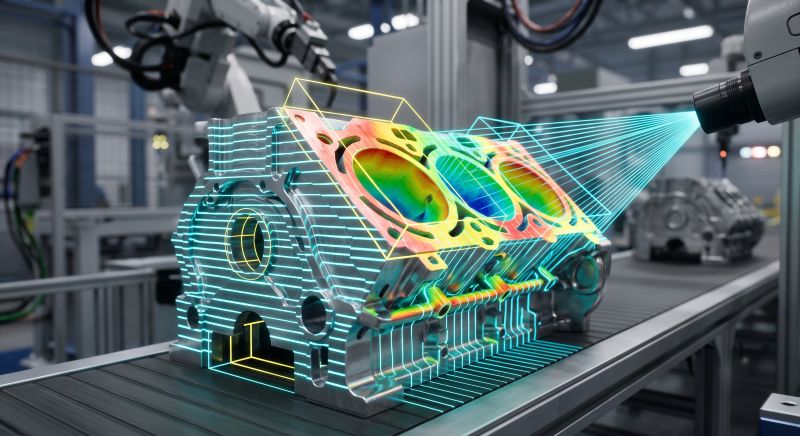
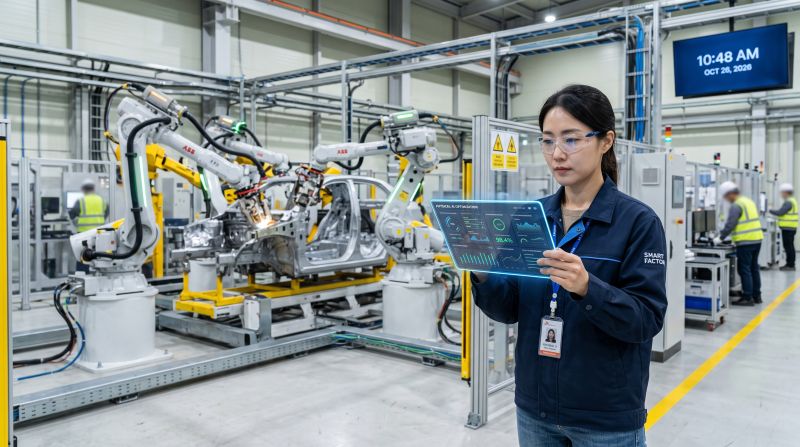
SKAI Intelligence resolves this critical "Sim-to-Real Gap"—the performance drop caused by discrepancies between virtual simulations and chaotic real-world factory environments—by building high-precision data infrastructure that transforms physical assets into machine-learnable training data.
🛰️ The 'Real2Sim2Real' Data Architecture
To overcome physical environment variables such as shifting lighting, surface textures, and camera sensor optics, SKAI Intelligence operates an end-to-end data pipeline:
-
Automated 3D Digital Twins: Combines AI-driven robotic scanning with CAD engineering files to generate hyper-accurate 3D models replicating exact object geometry and surface materials.
-
Real-World Environment Replication: Simulates precise field conditions, capturing microscopic surface imperfections, light reflections, and specific camera lens characteristics.
-
Automated Synthetic Data & Ground-Truth Extraction: Automatically synthesizes thousands of operational edge-case scenarios while extracting ground-truth labels, including 3D pose, depth, and spatial metadata.
-
Closed-Loop Data Flywheel: Feeds real-world robot execution metrics back into simulation environments, creating a continuous feedback loop that iteratively sharpens data precision.
🤖 Global Ecosystem Validation and Dual-Market Scalability
SKAI Intelligence’s technology is backed by leading global ecosystems across both industrial and commercial frontiers. In partnership with global robotics leader ABB, the platform embeds synthetic vision data directly into industrial simulation workflows. Native to NVIDIA Omniverse, its engine accelerates 3D asset generation by up to 95% compared to legacy CGI workflows. This dual-market foundation—further validated by winning the Grand Prize at the 2024 LVMH Innovation Award—creates a unique feedback loop where luxury visual realism continuously reinforces sensor-grade industrial perception data.
By converting chaotic physical reality into structured machine intelligence, SKAI Intelligence is establishing the foundational data layer required to power the era of Physical AI.
|
|
|
Decoding Korean Innovation |
|
|
Korea’s Inter-Ministerial Push: Accelerating Physical AI for SME Manufacturers |
|
|
South Korea is aggressively restructuring its SME manufacturing base by converging public R&D with real-world shop-floor automation. Through a joint strategic initiative, the Ministry of Science and ICT (MSIT) and the Ministry of SMEs and Startups (MSS) have established an end-to-end pipeline to accelerate the adoption of Physical AI—enabling autonomous perception, decision-making, and robotic execution across industrial environments.
🌐 Full-Stack Integration: 'AI Factory Manager' Meets Smart Manufacturing
The cornerstone of this collaboration merges MSIT’s 'AI Factory Manager for All' initiative with MSS’s established 'Smart Manufacturing Innovation' infrastructure:
-
Full-Stack Solution Deployment: Building on regional testbed validations—such as autonomous factory control in Jeonbuk and ultra-precision manufacturing intelligence in Gyeongnam—MSIT provides turnkey Physical AI operating software, design analytics, and procurement consulting.
-
Shop-Floor Implementation: MSS is integrating these full-stack AI solutions into its national Smart Factory rollout, establishing dedicated support programs for SMEs to adopt AI hardware and software simultaneously.
-
Data Feedback Platform: High-performing deployment benchmarks will be scaled across the ecosystem via the upcoming 'Manufacturing AI 24' integrated platform.
⚙️ Joint R&D for Strategic New Growth Verticals
Beyond factory-floor automation, MSIT and MSS are launching joint R&D programs targeting next-generation growth sectors, including defense/security, pharma-bio, climate-tech, and K-consumer goods (such as beauty):
-
Foundational to Applied Pipeline: MSIT will fund core foundational Physical AI algorithms and architecture, while MSS focuses on field demand, commercial viability, and real-world shop-floor validation.
-
Virtuous R&D Cycle: This complementary division of labor ensures early-stage technological breakthroughs transition rapidly into commercialized industrial solutions.
🚀 Public-Private Synergy via the 'Physical AI Alliance'
To bridge the gap between AI developers and industrial adopters, the government is mobilizing the 'Physical AI Alliance'—a public-private platform connecting government bodies, research institutes, and enterprises:
-
Dedicated SME Task Force: A specialized SME Task Force within the alliance will actively identify shop-floor pain points and match manufacturing demand with capable deep-tech providers.
-
Cross-Border Opportunities: By establishing standardized field testbeds and verified operational data, this framework provides global VCs and international technology partners with an ideal, de-risked environment to validate and deploy industrial AI solutions at scale.
|
|
|
4F, Startup Campus Building #3, 20, Pangyo-ro 289Beon-gil, Bundang-gu, Seongnam-si, Gyeonggi-do Korea 13488
You are receiving this email because you have visited our site or asked us about regular newsletter.
|
|
|
|
|