The New Space Race: Telepix, Korea’s latest AI trends One Step to Protect IP Across 27 EU Nations: EUIPO Visits GDIN |
|
|
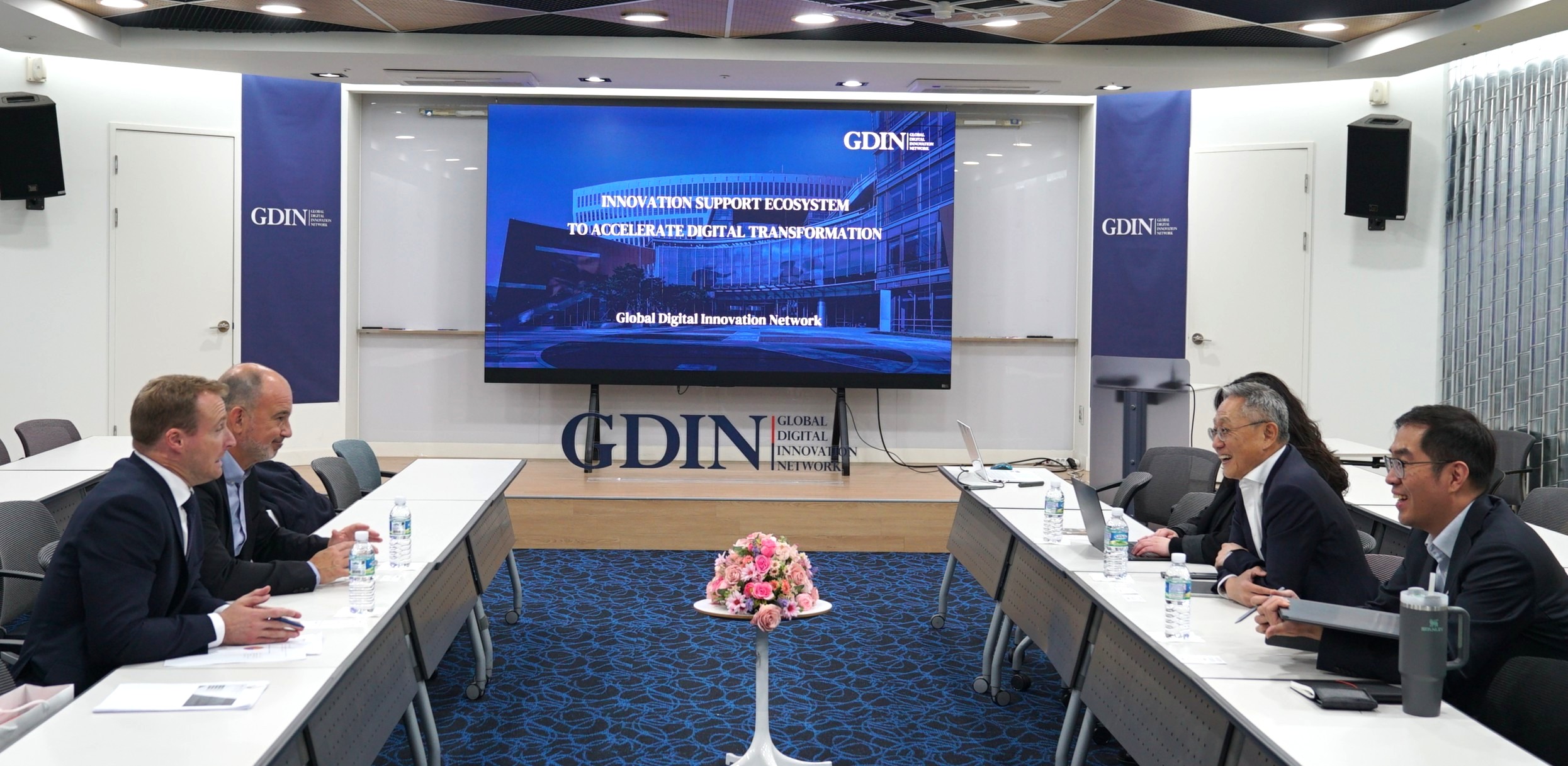
Expanding into the European market became significantly more accessible for Korean innovators. On April 8, GDIN welcomed a distinguished delegation from the European Union Intellectual Property Office (EUIPO), the agency responsible for managing trademarks, designs, and intellectual property across all 27 EU member states.
Navigating 27 different legal systems has long been a major hurdle for startups eyeing Europe. During the visit, Iganacio de Medrano Caballero, Head of Promotion of the IP System at EUIPO, highlighted a powerful solution: through a single registration with EUIPO, companies can secure intellectual property protection that is valid across the entire European Union.
The visit served as a springboard for direct engagement with the Korean startup ecosystem. Medrano emphasized that EUIPO is dedicated to innovating its processes to better support early-stage startups. By listening to the real-world challenges faced by Korean founders, EUIPO aims to reflect these insights in future system enhancements.
GDIN CEO Jongkap Kim noted that finding trustworthy local partners to navigate unfamiliar IP systems is often the first major hurdle for startups. He expressed his hope that this partnership will establish EUIPO as a reliable ally, ensuring that Korean innovations are not only created but also fully protected as they scale globally.
The visit concluded with an in-depth roundtable session led by Francisco Miranda de Sousa from EUIPO’s Business Development team. Participating startups including ZEZEDU, Anchor Node, EverTreasure, 3R Innovation, and AnyRactive along with patent attorneys from ON IP and MILESTONE IP, engaged in a deep-dive Q&A regarding practical trademark and design application procedures tailored to their European entry strategies.
|
|
|
-
People & Technology: The AI-powered smart hospital platform provider has successfully closed a KRW 15 billion SI Bridge funding round. The round was highlighted by a strategic investment from Dong-A ST, further solidifying the company’s position in the digital healthcare ecosystem.
-
Twinny: The autonomous logistics robot specialist has signed an MOU with LX Pantos, a leading global logistics company, to automate warehouse operations. Twinny’s AMR (Autonomous Mobile Robot) technology allows for precise indoor navigation and stable driving without the need for additional infrastructure.
-
Autonomous a2z: The Level 4 autonomous driving solution pioneer has entered a strategic partnership with HL Klemove, an HL Group subsidiary specializing in autonomous solutions. The two companies will collaborate to advance Level 4 autonomous driving technologies.
-
Hamada Labs: Enterprise automation specialist Hamada Labs is accelerating its global expansion with the establishment of its Japanese subsidiary, Hamada Labs Japan. Its multi-AI agent platform, 'WindyFlo,' automates repetitive tasks and supports data-driven decision-making for enterprises.
-
AITRICS: Medical AI company AITRICS has obtained medical device approval from the Indonesian Ministry of Health for 'AITRICS-VC,' an AI solution that predicts patient deterioration. The system analyzes Electronic Medical Record (EMR) data to provide early warnings for critical patient conditions.
|
|
|
The New Space Era: From Lunar Missions to AI-Driven Earth Intelligence |
|
|
The space sector is no longer a distant frontier; it is becoming a cornerstone of the global digital economy. With the recent momentum of the Artemis II mission and the buzzing anticipation surrounding SpaceX's IPO, investor attention is rapidly shifting toward SpaceTech.
This trend is truly global. Recently Spanish startup Xoople secured $130 million in Series B funding to build a comprehensive "Earth Map" specifically designed for AI training.
This underscores a clear market shift: the value is moving from just launching satellites to how we process and utilize space data using AI.
🇰🇷 Spotlight: Telepix – Leading the AI-Powered Satellite Revolution
While Silicon Valley and Europe are heating up, Korea’s Telepix is establishing itself as a world-class player in high-resolution optical payloads and AI-driven satellite data analysis.
-
Advanced Space AI & Payloads: Telepix specializes in the entire lifecycle of satellite data, developing ultra-high-resolution optical cameras (payloads) and integrating them with AI-based image processing.
-
Satellite-as-a-Service (SaaS): They provide actionable intelligence for diverse fields including climate monitoring, maritime security, and urban planning.
-
Expanding Footprint: Their global presence is growing rapidly, highlighted by a significant satellite export contract in Europe signed this past February.
-
Beyond the Lens: Unlike traditional hardware-centric space firms, Telepix focuses on high-quality "Physical AI" data. Their AI engine can detect changes in Earth's environment with extreme precision, meeting the sophisticated data demands of modern industries.
The "New Space" race is being won by companies that can bridge the gap between orbital hardware and earth-bound AI applications. Telepix stands as a prime example of how Korean SpaceTech is ready to serve the burgeoning global demand for space-based data intelligence.
|
|
|
Decoding Korean Innovation |
|
|
Beyond the Gap: Korea's Inclusive AI Journey |
|
|
In our previous edition, we explored how Generative AI is rapidly becoming a mainstream tool in Korea, with experience rates jumping significantly year-over-year. This week, we dive deeper into the same "2025 Survey on the Internet Usage" to uncover a more profound shift: how AI is bridging the digital divide across all generations.
1. The Silver Digital Surge: No One Left Behind
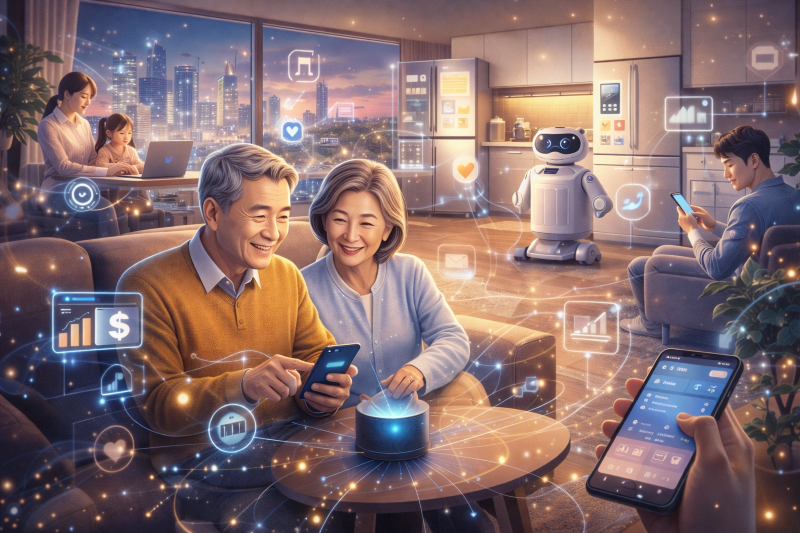
One of the most remarkable trends in the 2025 data is the rapid digital integration of the elderly.
-
Active Participation: The AI service experience rate for those in their 60s has reached 50.3%, and for those 70 and older, it stands at 34.7%.
-
Closing the Gap: The internet usage rate among seniors aged 70 and older has increased 1.7 times over the past five years.
-
Financial Independence: The usage of internet banking among the 5060 generation continues to rise steadily, with the 50s group reaching 92.1% and the 60s group at 82.4%.
2. AI for Everyday Comfort: The Domestic Frontier
Moving beyond professional productivity (which we noted in our last report ), AI in Korea is increasingly centered on improving the quality of domestic life.
-
Top Sector - Residential Convenience: The most frequently experienced AI service category is "Residential Convenience" (35.9%), which includes domestic service robots and smart home appliances.
-
Daily Integration: This is followed by Transport (25.6%), Communication (20.9%), and Education (19.1%).
-
Expanding Public Trust: A significant 66.8% of the population agrees that AI services provided by the government and corporations have a positive impact on society, a 12.2%p increase from the previous period.
3. Deeper Digital Engagement
As AI integrates further into daily life, the nation’s overall digital engagement continues its upward trajectory.
-
Increased Connectivity: The average weekly internet usage time has grown to 21.6 hours, up from 20.5 hours just a year ago.
-
Mobile-First Society: Mobile internet usage remains the dominant platform, reaching 94.1% in 2025.
Building on the Generative AI boom we discussed previously, Korea’s 2025 digital landscape proves that AI is evolving into a universal utility. By narrowing the digital divide for seniors and prioritizing residential convenience, Korea is setting a global benchmark for an inclusive AI-driven society.
|
|
|
Was this newsletter forwarded to you? Don't miss out on the next pulse of Korean innovation. Sign up here to get your own copy every week. |
|
|
4F, Startup Campus Building #3, 20, Pangyo-ro 289, Bundang, Seongnam, Korea 13488
You are receiving this email because you have visited our site or asked us about regular newsletter.
|
|
|
|
|