Omelet at XTC Summit, DEFINITE's cost OS & KDI 2027 forecast
GDIN Backs Korean AI Startup at the 2026 XTC AI:360 Summit
|
|
|
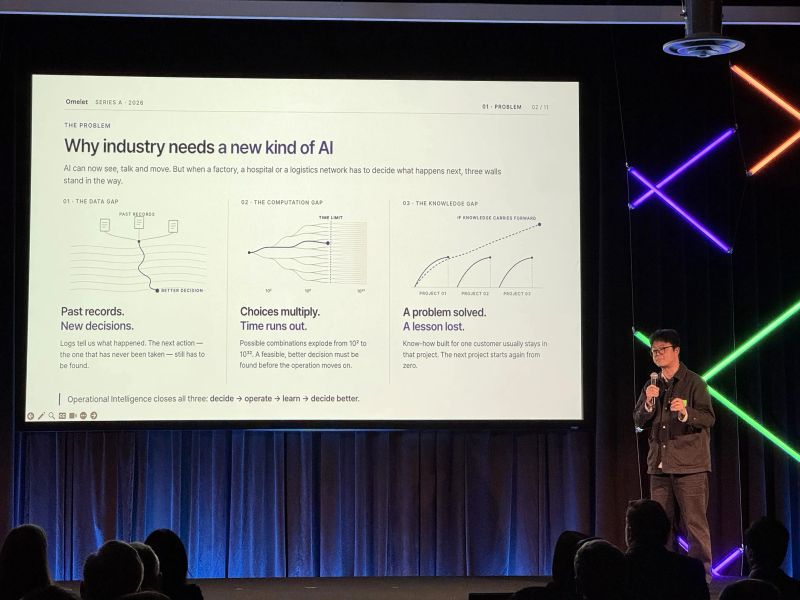
On November 19, GDIN supported Korean industrial AI startup Omelet in showcasing its solution at the 2026 XTC AI:360 Summit in Palo Alto, Silicon Valley. Held at deep-tech venture firm Playground Global and organized by Extreme Tech Challenge (XTC), the summit brought together around 200 global leaders across technology, energy, and innovation ecosystems under the theme "Applied Intelligence: Feed it, Run it, Use it."
During the summit’s Startup Showcase, Omelet CEO Jinkyoo Park introduced 'OaaSIS', a decision foundation model-based AI platform engineered to solve complex operational optimization challenges across manufacturing and logistics environments, drawing strong interest from global AI enterprises, venture investors, and policymakers.
Omelet earned its spot as Korea’s finalist out of eight competing domestic AI companies at the 'XTC Korea 2026' online IR pitching competition held in August. Co-hosted by GDIN, the National IT Industry Promotion Agency (NIPA), and XTC, the qualifier evaluated domestic AI innovators on the real-world applicability of their industrial decision-making technologies.
Co-founded by Young Sohn, Founding Managing Partner of Walden Catalyst Ventures and former Chief Strategy Officer (CSO) of Samsung Electronics, alongside Silicon Valley investor Bill Tai, XTC is a non-profit global innovation platform aligned with the UN Sustainable Development Goals (SDGs). Today, its network connects more than 10,000 startups across over 120 countries with more than 400 global venture capital firms and major enterprise partners.
Following the summit, GDIN will continue providing structured post-event support—including targeted follow-up networking and investor and corporate matchmaking—to help Omelet translate its Silicon Valley showcase into tangible business outcomes.
|
|
|
GDIN Shares Korea’s Tech Scale-Up Blueprint with India’s WeSchool
|
|
|
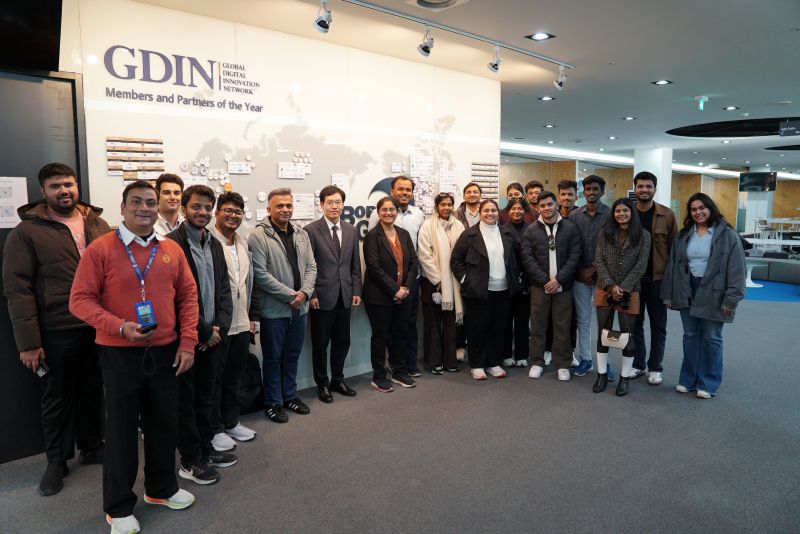
GDIN hosted a delegation of MBA students and faculty from India’s Welingkar Institute of Management (WeSchool), an institution recognized for its leadership in design thinking and entrepreneurship education, at the Pangyo Startup Campus. The visit centered on examining the structural drivers behind South Korea’s rapid technological ascent across the artificial intelligence and bio-healthcare sectors.
🌐 Decoding Korea’s Scale-Up Formula from Pangyo to Global Markets
-
Pangyo Techno Valley & Policy-Driven Scale-Up: GDIN Managing Director Sokjin Chang outlined the evolution of Pangyo Techno Valley into the nerve center of South Korea’s deep-tech economy, highlighting how targeted government policies and public-private R&D infrastructure have propelled domestic ventures toward unicorn valuations and IPOs.
-
Full-Cycle Global Commercialization Pipeline: Chang detailed GDIN’s end-to-end internationalization framework, demonstrating how the foundation de-risks cross-border expansion by connecting high-growth Korean startups with overseas enterprise partners, localized market-entry corridors, and global institutional investors.
⚙️ Cross-Border Dialogue on AI Governance and Data Policy
-
Balancing Innovation Velocity with Regulatory Safeguards: During an interactive Q&A session, WeSchool participants and GDIN leadership examined the global policy dilemma of sustaining agile regulatory environments that accelerate frontier AI and bio-health breakthroughs while establishing effective safety guardrails.
-
Cross-Border Data Flows as an AI Growth Catalyst: The discussion further addressed the strategic necessity of interoperable cross-border data frameworks, analyzing how secure international data mobility underpins next-generation AI development, multi-regional validation, and global venture scaling.
Moving forward, GDIN remains focused on expanding institutional exchanges with leading global business schools, innovation hubs, and emerging tech leaders. By cultivating substantive dialogue across high-growth markets such as India, GDIN continues to strengthen bilateral bridges and connect international talent with Korea’s deep-tech commercialization ecosystem.
|
|
|
🚀 InnoCSR: The climate-tech company launched a $60 million carbon finance project in partnership with Nepalese manufacturer Hulas Eco Bricks to decarbonize Nepal’s traditional coal-fired brick industry. Under the initiative, InnoCSR will deploy its proprietary non-fired 'Good Bricks' technology across 300 production facilities nationwide by 2030. Once fully operational, the sites are projected to produce approximately 3 billion eco-friendly bricks annually, cutting carbon emissions by up to 1.5 million metric tons per year. |
|
|
🚀 P2ACH AI: The in-store vision AI developer secured a commercial contract to deploy its retail intelligence solution, 'RAX', across 500 locations of a major Japanese convenience store chain following successful on-site PoCs. Combining upfront AI infrastructure deployment with recurring SaaS revenue, the agreement serves as the initial phase of a chain-wide rollout. By scaling across the retailer's entire store network, P2ACH AI projects a total commercial opportunity valued at KRW 50 billion (approx. $36 million). |
|
|
🚀 Colosseum Corporation: The global supply chain management (SCM) and logistics platform executed an MoU with Chinese third-party logistics provider Aixiang Supply Chain Technology to streamline bilateral Korea-China cross-border fulfillment. The partnership integrates Colosseum’s domestic logistics network and AI-driven warehouse automation with Aixiang’s local fulfillment infrastructure across China. By synchronizing two-way import and export workflows, the alliance establishes an end-to-end cross-border distribution corridor for e-commerce and enterprise shippers. |
|
|
🚀 Pablo Air: The swarm AI aviation and defense platform company was appointed sole operator for five pyrotechnic drone shows across state events in Oman and Ghana. Powered by its proprietary swarm coordination technology and a pyrotechnic control patent co-registered with Hanwha, Pablo Air is deploying up to 1,300 drones for Oman’s National Day and Armed Forces Day, while executing the first drone show in Africa by a Korean firm at Accra's Korea-Africa Drone Expo. These deployments anchor its commercial expansion across the Middle East and Africa.
|
|
|
DFINITE: Ontology-Driven Manufacturing Cost & P&L OS Eliminating Profit Leakage |
|
|
Across industrial manufacturing, fluctuations in raw material prices, yield degradation, and shifting process conditions directly erode operating margins. Yet while manufacturers accumulate vast operational datasets across ERP, MES, and SCM platforms, most remain trapped in "analytical fragmentation"—requiring days of manual reconciliation to isolate the root causes of cost variances and restricting leadership to reactive, post-mortem adjustments.
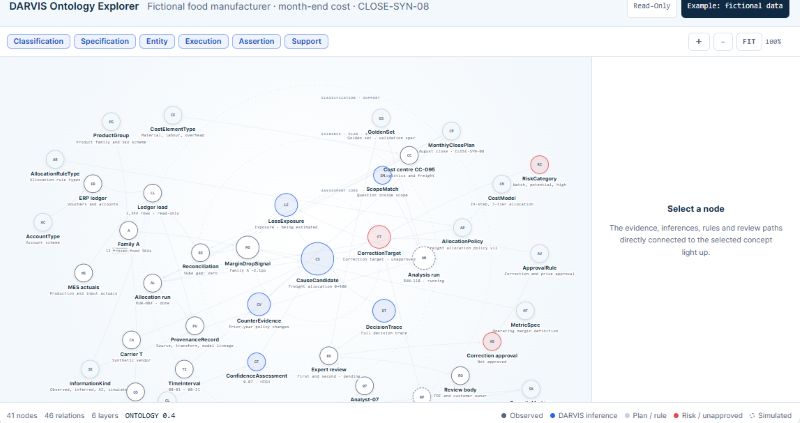
Industrial AI startup DFINITE is resolving this structural bottleneck with 'DARVIS', an ontology-based manufacturing cost and profit-and-loss (P&L) decision-making operating system that establishes a new benchmark for industrial AI transformation (AX).
🛰️ Ontology Data Fabric & Autonomous Root-Cause Engine
DARVIS bridges disconnected shop-floor and enterprise data systems to automate financial variance diagnosis and operational response:
-
Non-Invasive Read-Only Ontology Integration: Without requiring costly replacements of legacy ERP, MES, or SCM infrastructure, DARVIS connects via read-only interfaces and structures relationships across products, Bills of Materials (BOM), raw materials, processes, and equipment into a unified knowledge graph.
-
Automated Causal Tracing & Financial Quantification: Moving beyond static BI dashboards and context-blind general LLMs, the platform proactively detects cost and margin anomalies, cross-referencing source accounting vouchers with real-time process data to isolate root causes and calculate exact financial impacts.
-
Actionable Prescriptions & Institutional Decision Memory: Beyond diagnostics, DARVIS recommends concrete operational interventions—such as production line reallocations or process parameter adjustments—while capturing operator approvals and outcomes to convert individual domain expertise into permanent organizational assets.
💡 Proven Enterprise Efficiency & ASEAN Industrial Expansion
Validated across major domestic manufacturing facilities, DFINITE is scaling its industrial AI architecture across global innovation hubs and high-growth Asian production corridors:
-
Quantified Margin & Closing Efficiency in Production: Deployed across more than 10 paying enterprise and public-sector clients—including major Korean conglomerates and mid-sized manufacturers—DARVIS has reduced monthly P&L closing and variance analysis times by 97%, from three hours to five minutes, backed by registered core patents and selection for Korea’s Super-Gap Startup Project.
-
Global Ecosystem Validation Across North America and Europe: Demonstrating international technical competitiveness, DFINITE was named to the 'NVIDIA Inception Grand Challenge 2026 Top 80' and established cross-border collaboration with Spain’s Basque manufacturing innovation hub, BAT Tower.
-
Scaling Industrial AX Across ASEAN Manufacturing Hubs: Building on its proven domestic reference architectures, DFINITE is targeting commercial expansion into major ASEAN manufacturing economies—including Vietnam and Indonesia—where rapid industrial scaling drives urgent demand for AI-led cost and yield optimization.
By transforming fragmented shop-floor data into a unified, decision-ready ontology, DFINITE is moving industrial enterprises beyond reactive cost accounting toward real-time, margin-protective operations.
|
|
|
Decoding Korean Innovation |
|
|
KDI Projects 3.9% GDP Growth in 2027 Amid AI Boom & Structural Shifts |
|
|
According to the 2026 Second Half Economic Outlook released by the Korea Development Institute (KDI), South Korea’s economy is projected to record 3.9% real GDP growth in 2027, building on an estimated 3.8% expansion in 2026. Driven by sustained global AI infrastructure investments fueling semiconductor exports and facility investment, the outlook assumes 3.4% global economic growth. Under these conditions, KDI anticipates that income gains from the semiconductor upcycle will gradually spill over into household earnings and private consumption.
🌐 Export and CapEx Momentum Coupled with Domestic Demand Recovery
KDI’s 2027 growth trajectory reflects strong external trade balances transitioning into broader domestic economic activity:
-
Sustained Export and Investment Growth Alongside Record Surplus: Buoyed by ongoing demand for semiconductors and AI infrastructure hardware, total exports and facility investment are both projected to grow by 8.1% in 2027. Improved terms of trade and robust export performance are expected to expand the current account surplus to approximately $601.3 billion, surpassing the $516.2 billion projected for 2026.
-
Broadening Private Consumption, Employment, and Inflation Dynamics: Supported by lower energy costs and semiconductor-driven income spillovers, private consumption growth is forecast to accelerate from 1.8% in 2026 to 2.4% in 2027 (reaching 3.1% in the second half), while annual job additions expand to 200,000 from 120,000 in 2026. Headline consumer inflation is projected to ease to 2.4% (down from 2.7% in 2026), though rising demand-side pressures will keep core inflation at 2.5%, above the 2.0% stability target.
⚙️ Managing Semiconductor Concentration Risks and Productivity Gaps
Despite strong headline growth, KDI underscored structural vulnerabilities tied to sector concentration and uneven industrial productivity:
-
Heightened Exposure to Global AI CapEx Cycles: As the computer, electronics, and optical equipment manufacturing sector—led by semiconductors—surged to 20.7% of nominal GDP in the first half of 2026 (up from a 2022–2025 average of 7.5%), Korea’s growth trajectory has become increasingly sensitive to global AI investment cycles. Potential delays in U.S. AI data center construction or tighter borrowing conditions among global big-tech firms pose downside risks, alongside sustained monetary tightening to contain core inflation.
-
Bridging the Non-Semiconductor Productivity Divide: Between 2011 and 2025, revenue productivity in semiconductor manufacturing expanded at an annual average of 11.3%, whereas non-semiconductor sectors averaged just 1.0% growth—contracting by 0.4% annually between 2021 and 2025. KDI emphasized that structural reform and new industrial growth engines are critical to narrowing inter-industry wage polarization and reducing the share of marginal firms.
Against this macroeconomic backdrop—and reinforced by South Korea’s 2027 budget proposal, which increases national R&D spending by 11.2% and targets Physical AI, AI data centers, and semiconductors as core investment pillars—several deep-tech startup verticals are positioned for accelerated growth. In particular, ventures developing ultra-low-power AI chips and data center efficiency infrastructure, Physical AI innovators, and B2B AI/digital transformation (AX/DX) solution providers modernizing non-semiconductor industries are poised to capture strong commercial demand.
For global investors and enterprise partners, these high-growth segments represent compelling opportunities backed by both urgent industrial need and sustained public-sector capital.
|
|
|
4F, Startup Campus Building #3, 20, Pangyo-ro 289Beon-gil, Bundang-gu, Seongnam-si, Gyeonggi-do Korea 13488
You are receiving this email because you have visited our site or asked us about regular newsletter.
|
|
|
|
|