Plus: Baycon's SaaS, AI chips, autonomous driving & medtech GDIN Recognized at the 2026 Startup Ecosystem Stars Awards |
|
|
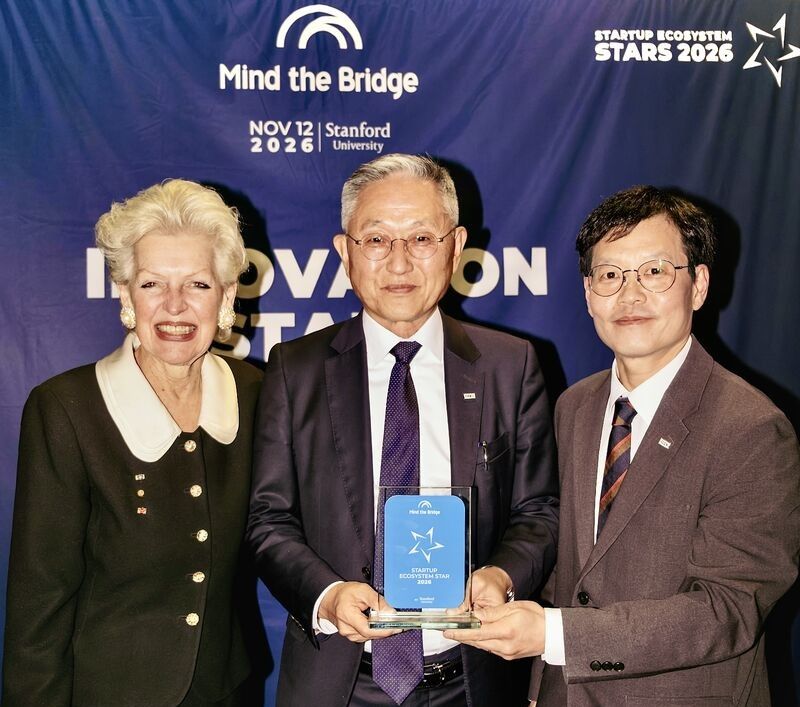
On November 12, GDIN received the 2026 Startup Ecosystem Stars (SES) Award at Stanford University. Organized by Silicon Valley-based open innovation advisory firm Mind the Bridge in collaboration with the International Chamber of Commerce (ICC), the annual awards recognize organizations driving measurable cross-border ecosystem growth. The selection reflects GDIN’s institutional role in connecting Korean deep-tech ventures with global enterprise, research, and capital networks.
🌐 Cumulative Track Record in Global Venture Scaling
-
Decade-Long Ecosystem Impact: Originally founded in 2013 as the Born2Global Centre and transitioned into an independent foundation in 2023, GDIN has supported more than 3,300 Korean technology startups and scale-ups in structuring and executing their international expansion strategies.
-
Cross-Border Capital Facilitation: Through targeted investor matchmaking and global market validation programs, GDIN has helped facilitate approximately $4 billion in cumulative investment across participating ventures.
🤝 Institutional Corridors & Cross-Border Infrastructure
-
Multi-Regional Partner Network: GDIN operates an active global network of over 330 institutional partners across more than 40 countries, spanning international organizations, multinational corporations, universities, and venture capital firms.
-
Localized Landing Hubs: Beyond bilateral matchmaking, GDIN has established dedicated cross-border operational corridors—including Korean Valleys in Brazil and strategic collaboration frameworks with IT Park Uzbekistan—to de-risk market entry and accelerate local B2B partnerships.
This recognition underscores the operational effectiveness of GDIN’s cross-border commercialization model. Moving forward, GDIN remains focused on strengthening institutional bridges and converting international technical collaboration into tangible commercial outcomes for Korean innovators. |
|
|
🚀 Autonomous a2z: The autonomous driving technology developer deployed its proprietary driverless shuttle, 'ROii', in its first public-road field trial in Japan across a 1.8-kilometer route in Toyooka's Kinosaki Onsen district, Hyogo Prefecture. Engineered as a Level 4 autonomous platform accommodating up to 11 passengers, the vehicle is undergoing rigorous operational validation across Japan’s left-hand traffic environment and narrow street infrastructure. By verifying transit reliability under complex local road conditions, the initiative establishes an operational benchmark to accelerate commercial autonomous mobility deployments across Japan. |
|
|
🚀 People and Technology: The smart hospital solution provider initiated a field PoC at Prince Sultan Military Medical City (PSMMC), the largest medical institution under Saudi Arabia’s Ministry of Defense. Powered by its 'IndoorPlus+ SmartCare' platform, the deployment integrates three core modules: wearable patient monitoring and medical asset tracking in stroke wards, indoor wayfinding to streamline outpatient flows, and an IoMT-based integrated command center. By leveraging existing hospital infrastructure to accelerate clinical response times and reduce staff workloads, the trial establishes a scalable model for broader Middle Eastern healthcare deployments. |
|
|
🚀 WIZCORE: The industrial AI solution provider won the CES 2027 Best of Innovation Award in the Art Tech category for 'CADian TWArch Master', its AI-powered traditional wooden architecture design software. Fusing a proprietary CAD parser algorithm with multimodal Text-to-CAD engines, the platform automatically converts hand-drawn historical blueprints into editable 2D and 3D digital models while enabling natural-language design modifications. Building on this recognition, WIZCORE plans to scale its generative engineering architecture beyond construction into heavy industrial verticals, including shipbuilding, defense, and plant engineering. |
|
|
🚀 Rebellions: The AI semiconductor startup partnered with NVIDIA and SK Telecom to advance disaggregated sovereign AI infrastructure utilizing 'NVLink Fusion' interconnect technology. Implemented on NVIDIA’s standard MGX rack architecture, the disaggregated inference system assigns generative decode workloads to Rebellions’ power-efficient next-generation NPU, 'R200'. Engineered to maximize frontier AI inference performance while substantially lowering data center total cost of ownership (TCO), the joint infrastructure architecture is slated for commercial deployment in 2028.
|
|
|
Baycon: Full-Stack Connectivity SaaS Eliminating Cross-Border Telecom Friction |
|
|
While downloadable eSIMs have become standard for international travel, conventional travel eSIMs remain constrained by a critical limitation: they provide mobile data only. Business travelers and enterprise teams abroad cannot receive incoming voice calls on their original domestic phone numbers or receive SMS one-time passwords (OTPs) required for banking and institutional authentication. Cross-border connectivity innovator Baycon is resolving this fragmented experience by replacing hardware-bound telecom workflows with a unified, cloud-based Connectivity SaaS platform.
🛰️ Cloud IP PBX Architecture & Full-Stack Telemetry
Rather than operating as a simple data reseller, Baycon runs proprietary telecom switching infrastructure engineered for enterprise-grade reliability:
-
Unified Full-Stack Connectivity ('oneSIM'): While competitors restrict offerings to localized data packages, Baycon integrates mobile data across more than 130 countries with local Direct Inward Dialing (DID) number issuance, financial and government SMS verification, and global voice termination on a single platform.
-
Seamless Home-Number Retention: Powered by its self-developed Cloud IP PBX and mobile VoIP engine, 'oneSIM' enables users abroad to place and receive calls using their existing domestic phone number with the same caller ID displayed, eliminating the need for secondary devices or manual app switching.
-
Global PoP Server Backbone: To prevent latency and call drops across international borders, Baycon routes voice and data traffic through more than 10 global Internet Data Center (IDC) Point of Presence (PoP) servers spanning North America, South America, Europe, the Middle East, and Asia-Pacific.
💡 Japan Market Integration & Enterprise/Public-Sector Traction
Backed by global investors including 500 Global and Shorooq Partners, Baycon has paired its Korean cloud engineering with local telecommunications infrastructure to scale across high-barrier enterprise and public-sector markets:
-
Integrated Japan Operational Hub: Building on an eight-year operational footprint serving over 260,000 Japanese corporate clients, Baycon has established deep operational integration with Japanese telecom affiliate SoftBay. This structure combines Baycon’s core cloud software platform with local carrier, regulatory, and distribution capabilities across Japan.
-
Enterprise, Municipal, and Defense Deployments: Through its integrated Japan hub, Baycon supports mission-critical communications across major B2B and B2G sectors—including a leading Japanese AI business travel platform serving 150,000 corporate users, municipal-wide 'oneSIM' adoption for a major Japanese city government, and enterprise VoIP integration supporting 45,000 defense personnel.
-
Global Travel & Enterprise Distribution: Expanding beyond Northeast Asia, Baycon is scaling distribution through strategic partnerships across aviation, online travel agencies (OTAs), and global airport lounge networks, delivering plug-and-play cross-border connectivity for international workforces.
By replacing legacy physical telecom hardware with cloud-native software and direct carrier integrations, Baycon is eliminating cross-border communication barriers and establishing a scalable connectivity layer for global enterprises. |
|
|
Decoding Korean Innovation |
|
|
South Korea Ranks 3rd Globally in AI Tech and Efficiency in 2026 IMD Index |
|
|
On November 11, the Swiss-based International Institute for Management Development (IMD) released its 2026 World Digital and AI Ranking (WDAIR), placing South Korea 3rd globally in both Technology & Infrastructure and Efficiency, and 10th overall among 70 evaluated economies.
Rebuilt from IMD’s former World Digital Competitiveness Ranking to measure how effectively nations build, deploy, and govern artificial intelligence across 88 indicators, the index also ranks Korea 3rd in the Asia-Pacific region and 4th among economies with populations exceeding 20 million. Advancing across all five evaluation pillars, Korea stands alongside the United States and China as one of the world's top three powerhouses in core AI technological capacity and operational execution.
🌐 Global Top-3 Standing in AI Infrastructure & Commercial Execution
Highlighted in IMD’s analysis as a premier "research-driven industrial model," Korea achieved top-three global rankings in both Technology & Infrastructure and Efficiency:
-
Top-Tier R&D & Research Backbone (3rd in Technology & Infrastructure): Climbing four spots from 7th, Korea leads the world in total R&D expenditure as a share of GDP (1st) and ranks 3rd globally in the Research Infrastructure sub-factor. Strong output across AI-related patent publications (3rd) and AI academic articles (8th), paired with improved venture capital availability (up 11 spots to 35th), reinforces its deep-tech commercialization pipeline.
-
Rapid Enterprise & Market Adoption (3rd in Efficiency): Surging 10 spots from 13th, Korea ranks 3rd in Business Agility and 6th in the overall AI Adoption sub-factor. Individual metrics underscore fast private-sector integration, with Korea placing 8th in the newly introduced AI Adoption Index and jumping 26 spots to 20th in corporate agility.
⚙️ Public-Sector Digital Leadership, Workforce Readiness & Institutional Trust
Beyond hardware and industrial capacity, Korea posted broad-based gains across institutional governance, human capital, and societal trust:
-
World-Leading Digital Government & Public-Private Synergy (27th in Governance): Rising seven spots from 34th, Korea ranked 1st globally in both the Core Government Systems Index and the Public Service Delivery Index, while public-private partnerships supporting technology development jumped 24 spots to 35th.
-
AI-Ready Talent & High Citizen Trust (20th in Workforce Development, 16th in Values): Supported by strong STEM education (7th in Education & Training), Korea ranked 8th in the new AI Readiness Index and 12th in the AI Education Index, while advancing 17 spots to 44th in attracting foreign highly skilled talent. Simultaneously, Korea placed 10th globally in citizen trust in AI and 7th in national image and branding, reflecting strong public and international confidence in its digital ecosystem.
Korea’s top-three global standing in infrastructure and efficiency underscores the speed at which its R&D intensity and enterprise agility translate into real-world AI deployment. For global enterprises, institutional investors, and technology partners, South Korea offers a high-velocity proving ground combining frontier digital infrastructure, proactive public-sector adoption, and a receptive commercial market. |
|
|
4F, Startup Campus Building #3, 20, Pangyo-ro 289Beon-gil, Bundang-gu, Seongnam-si, Gyeonggi-do Korea 13488
You are receiving this email because you have visited our site or asked us about regular newsletter.
|
|
|
|
|