Korea’s tech incorporations surge 14.2% GDIN Forges Strategic Healthtech Gateway to Europe with Luxinnovation |
|
|
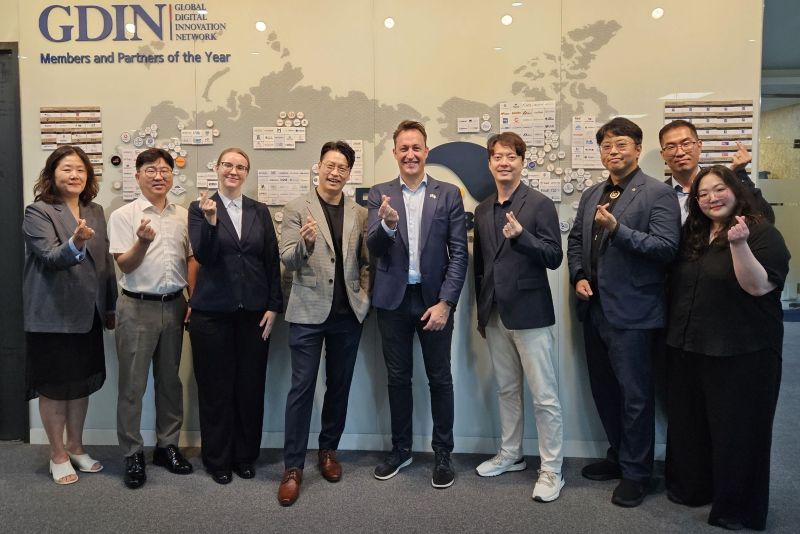
On August 21, GDIN hosted a strategic alignment session with Luxinnovation, Luxembourg’s national innovation agency, and the Embassy of Luxembourg in Seoul. The bilateral meetup was designed to establish a robust cross-border pipeline, positioning Luxembourg as the premier strategic hub for South Korea's most promising healthtech and biometrics innovators seeking to penetrate the European market.
During the session, Régis Ciré, Head of the Healthtech Sector at Luxinnovation, articulated the evolving European healthcare regulatory landscape and outlined Luxembourg’s centralized institutional framework for accelerating market entry.
The event featured targeted pitches from four deployment-ready Korean deep-tech enterprises, showcasing their cross-border commercial viability to European stakeholders:
-
EverEx: Showcased its AI-powered musculoskeletal assessment and personalized digital rehabilitation solutions.
-
Orange Biomed: Presented its fast, lab-accurate microfluidic HbA1c testing infrastructure for chronic diabetes management.
-
S-Alpha Therapeutics: Highlighted its digital therapeutics (DTx) engineered to clinically slow pediatric myopia progression.
-
WINNING.I: Demonstrated its software-defined, contactless biometric authentication (fingerprint/palmprint) leveraging standard mobile optics.
Moving forward, GDIN will continue to leverage its institutional network to facilitate direct market validation, regulatory compliance, and joint commercial deployments for Korean healthtech startups scaling across Europe.
|
|
|
🚀 Haii: The digital healthcare specialist secured official designation from the Ministry of Food and Drug Safety as an Innovative Medical Device for 'Repeech,' its dysarthria speech rehabilitation solution. As a standalone Software as a Medical Device (SaMD), the platform empowers post-stroke patients to undergo personalized at-home speech therapy under remote clinical supervision, setting a new benchmark for accessible digital language rehabilitation.
|
|
|
🚀Rebellions: The AI semiconductor pioneer partnered with UK-based AI computing startup Callosum to supply over 100 NPU-driven computing racks to a UK government-backed AI research cluster. By co-designing a reference architecture that embeds Rebellions' NPUs as dedicated inference hardware into the Callosum platform, the partnership enables global enterprises to rapidly deploy high-efficiency AI infrastructure without additional optimization friction.
|
|
|
🚀 XYZ: The AI robotics innovator signed a Memorandum of Understanding (MOU) with Chinese robotics firm Galaxea AI to integrate its proprietary robot intelligence framework, ‘BrainX,’ directly onto Galaxea’s hardware line. The collaboration focuses on commercializing customized automation applications across real-world operational environments, including retail task automation, apparel folding, and smart factory management. |
|
|
🚀 H2O Hospitality: The hospitality tech leader executed a commercial agreement with major hotel chain Rotana Group to deploy its smart check-in infrastructure across 15 property locations comprising 4,240 rooms in Abu Dhabi. Combining mobile pre-check-in with AI-driven facial recognition technology, H2O Hospitality has established a proven operational benchmark to scale its contact-free guest automation solutions across broader Europe, Middle East, and Africa (EMEA) markets.
|
|
|
HyperAccel: Redefining AI Infrastructure Through Token Efficiency |
|
|
The Generative AI market is currently confronting a critical "LLM Cost Paradox." While the per-token computational price is dropping rapidly, the total cost of AI infrastructure is surging. This is driven by the evolution of 'Agentic AI' and advanced reasoning models, which consume 10x to 100x more tokens to execute complex tasks. Furthermore, as hyperscalers build GW-scale AI data centers, the primary constraint has shifted from capital to power availability, with traditional GPUs consuming nearly 40% of total data center electricity. HyperAccel, a pioneering AI semiconductor startup, resolves this structural deadlock with its purpose-built LLM Processing Unit (LPU).
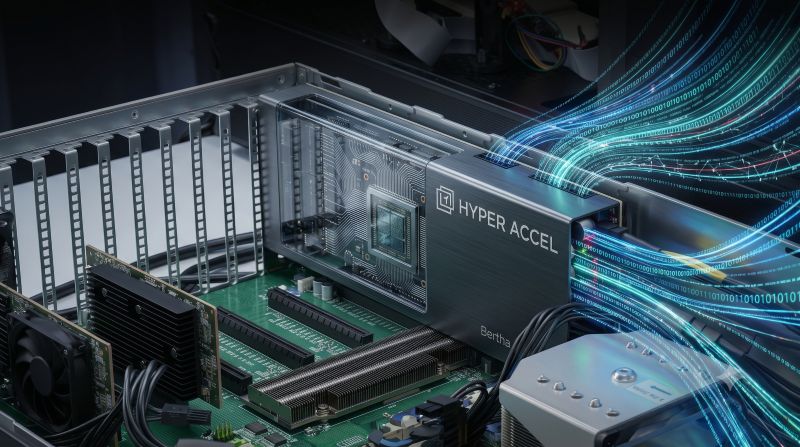
🛰️ Purpose-Built Architecture for Token Processing Traditional GPUs suffer from memory bandwidth bottlenecks during LLM inference tasks. HyperAccel’s LPU, 'Bertha,' introduces a 'Streamlined Dataflow' architecture natively optimized for transformer models. By precisely aligning memory and compute bandwidths, the LPU achieves an unprecedented ~90% hardware utilization rate. Moreover, rather than relying on expensive and power-hungry High Bandwidth Memory (HBM), Bertha innovatively leverages LPDDR5X memory, significantly minimizing both hardware costs and energy footprints without compromising inference throughput.
🤖 Setting a New Benchmark in Cost and Energy Efficiency HyperAccel is aggressively targeting both cloud data centers and on-device physical AI. Its flagship data center chip, the Bertha LPU, supports up to 1024 concurrent batch requests with a robust 546 GB/s memory bandwidth. Commercially, this architecture delivers up to 6.2x better cost efficiency and 5.7x higher power efficiency compared to state-of-the-art GPUs across key workloads. For the physical AI and consumer electronics sector, the 'Bertha-Edge' offers a sub-15W TDP solution optimized for real-time edge computing.
Founded by KAIST Professor Joo-Young Kim, who brings deep hardware acceleration expertise from Microsoft, HyperAccel's technological supremacy has been globally validated, winning the 2024 IEEE Micro Best Paper Award and the IC Taiwan Grand Challenge. By fundamentally restructuring how tokens are processed, HyperAccel is actively paving the most sustainable hardware pathway for the era of Agentic AI.
|
|
|
Decoding Korean Innovation |
|
|
Korea’s H1 2026 Startup Trends: Tech-Based Incorporations Rise 14.2% |
|
|
South Korea’s venture ecosystem is undergoing a structural shift toward technology and knowledge-intensive sectors. According to the Ministry of SMEs and Startups (MSS), while total new business registrations experienced a marginal 1.5% decline to 565,640 in the first half (H1) of 2026, technology-based startup incorporations surged by 14.2% year-over-year, reaching 123,418. Consequently, tech-driven enterprises now account for 21.8% of all new ventures, marking a 3.0 percentage point increase from the previous year.
🌐 The ICT & Knowledge Service Explosion
The tech sector growth was overwhelmingly led by Information and Communication Technology (ICT), which recorded a 59.4% year-over-year spike in new venture creation. This momentum was further backed by growth across knowledge-based service verticals, notably professional, scientific, and technical services (up 6.9%), and education services (up 4.4%).
⚙️ Maturation of Corporate Infrastructures
Reflecting a shift toward scalable business models, individual proprietorships contracted by 2.1% (down 10,981 entities), whereas corporate incorporations expanded by 4.4%, adding 2,125 new corporate entities. This formalization highlights an ecosystem increasingly optimized for structural R&D, cross-border viability, and institutional venture capital attraction.
🚀 Macro Synergy with Global AI Demand
This micro-level surge in tech startups aligns with South Korea's macro-economic trajectory, currently propelled by global AI infrastructure momentum. Driven by surging global semiconductor demand, the Korea Development Institute (KDI) has officially upgraded the nation's 2026 GDP growth forecast to 3.2%, alongside an upward revision of domestic facility investment growth to 7.9%. This synergetic convergence of macro capital expenditure and early-stage tech formation solidifies a resilient ecosystem for Korea's emerging innovators.
|
|
|
4F, Startup Campus Building #3, 20, Pangyo-ro 289Beon-gil, Bundang-gu, Seongnam-si, Gyeonggi-do Korea 13488
You are receiving this email because you have visited our site or asked us about regular newsletter.
|
|
|
|
|