ALCE aerospace partnership & P2ACH AI's retail tech Mapping Aerospace Opportunities Between Korea and Latin America |
|
|
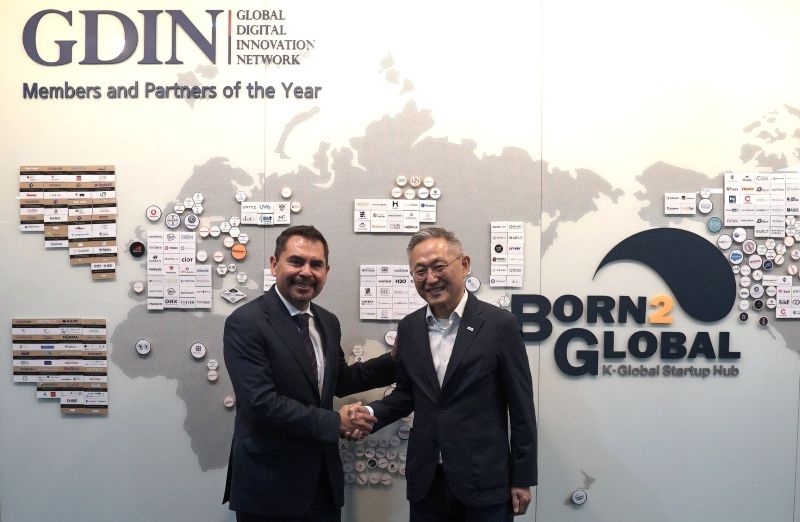
On August 21, GDIN hosted a high-level delegation from the Latin American and Caribbean Space Agency (ALCE), led by Secretary-General Dr. Óscar Fredy González Rivera. The high-level meeting was designed to establish a robust cross-border commercial pipeline, seamlessly connecting South Korea's rapidly maturing 'New Space' ecosystem with Latin America's surging aerospace infrastructure demands.
Highlighting the structural alignment between the two regions, GDIN CEO Jongkap Kim anchored the partnership within the framework of South Korea’s '7 SEED' national blueprint, which designates the aerospace sector as a critical engine for next-generation technological sovereignty. In response, Dr. González Rivera emphasized ALCE’s mandate as the centralized institutional gateway for coordinating aerospace financing and technology deployment across its member states. Citing the region's vast geographical footprint, he noted an immense, untapped market for localized satellite communications and geospatial solutions, expressing strong intent to source private-sector deep-tech through the GDIN and MoneyToday-backed 'K-Space Forum.'
During the session, leading hardware and data enterprises from the K-Space Forum presented deployment-ready architectures directly tailored to ALCE’s regional development roadmap:
-
🛰️ CONTEC: The satellite data and ground station specialist proposed scalable integration of its global data-reception network, directly supporting ALCE’s mandate to build an integrated, multi-nation regional monitoring infrastructure.
-
🔭 CSO (Cognitive Space Optics): The hardware innovator showcased its ultra-high-resolution optical payloads for small form-factor satellites, exploring direct supply-chain participation in ALCE’s 'LA-SAT' project—Latin America’s first regional nano-satellite constellation.
Moving forward, GDIN will continue to leverage its institutional framework to facilitate joint initiatives, structural financing, and direct market entry for Korean aerospace startups targeting Latin America's expansive space economy.
|
|
|
🚀 Trenfit: The cross-border commerce innovator officially launched 'Clossie,' an AI-powered export platform designed to scale emerging South Korean fashion brands globally. Powered by a predictive AI engine that analyzes cross-border consumer purchasing data and behavioral metrics, the platform automates localized product curation. Furthermore, Trenfit has established its official UK subsidiary, laying the localized operational infrastructure for integrated logistics and targeted marketing to accelerate its European market penetration.
|
|
|
🚀Puzzle AI: The medical AI specialist is deploying its automated clinical documentation system, 'PuzzleGen,' to comprehensive hospitals in Japan in collaboration with local partner Espeon. The deployment leverages Puzzle AI’s proprietary Japanese-language medical speech recognition alongside a screen-aware AI agent. Crucially, this agentic technology autonomously understands and controls existing user interfaces without requiring complex Electronic Medical Record (EMR) integrations, seamlessly automating everything from diagnostic logging to repetitive clinical forms to spearhead digital transformation across Japanese healthcare facilities.
|
|
|
🚀 AIZEN Global: The AI fintech pioneer secured a senior secured credit facility from ALMA, a U.S.-based global private credit investment firm. Powered by ALMA’s institutional credit platform and impact capital, AIZEN Global will aggressively scale its proprietary 'CreditConnect' platform and EV-focused 'Vertical AI' engine across Southeast Asia. By analyzing real-time, unstructured telemetry data—such as EV driving metrics and battery state of health (SOH)—the technology automates dynamic credit scoring for underbanked ride-hailing drivers. Building on its validated operational traction in Indonesia, AIZEN Global will use this capital to expand EV fleet financing and accelerate cross-border electrification across Vietnam and broader regional markets |
|
|
🚀 AIRS Medical: The medical imaging AI leader secured a 7.5 billion KRW strategic investment from the Export-Import Bank of Korea (KEXIM)—marking the state-run bank's first-ever direct venture investment since its inception. This landmark funding validates AIRS Medical’s deep-learning software, which seamlessly integrates into existing hardware to reduce MRI scan times by up to 50% while maintaining high diagnostic image quality. This capital injection will serve as a strategic catalyst to aggressively accelerate the company’s global market share expansion in the digital healthcare sector.
|
|
|
P2ACH AI: Transforming Physical Retail with Privacy-Preserving Vision AI |
|
|
While digital advertising relies on hyper-targeted analytics and deterministic Return on Ad Spend (ROAS) metrics, physical retail and Out-of-Home (DOOH) media have long struggled with unquantifiable conversion attribution, fragmented customer journey data, and privacy constraints. P2ACH AI is overcoming these structural limitations by engineering an Edge Vision AI infrastructure that converts physical storefronts into measurable, data-driven environments. Functioning as "Google Analytics for offline spaces," P2ACH AI equips enterprise retailers and advertisers with actionable foot-traffic intelligence, real-time inventory tracking, and programmatic ad delivery—all while guaranteeing absolute data sovereignty.
🛰️ Privacy-First On-Device Intelligence: The RAX-Z Architecture
At the core of P2ACH AI’s framework is RAX-Z, an edge-native retail media platform powered by proprietary NPU-equipped hardware (6 TOPS AI BOX) and specialized vision sensors. Leveraging autonomous driving gaze-recognition algorithms paired with low-latency on-device homomorphic encryption, RAX-Z analyzes demographic metrics, customer dwell times, and visual engagement locally without storing raw video logs. Fully GDPR and ISO 27001 certified, the single-device architecture supports real-time programmatic ad bidding and precise ad-to-purchase attribution.
🤖 Whole-Store Automation: RAX-Flow & RAX-E
P2ACH AI extends beyond media optimization to drive full-cycle store automation across a unified hardware pipeline:
-
RAX-Flow: Utilizes multi-camera Re-Identification (Re-ID) technology to track customer movements as "offline cookies," mapping the end-to-end purchasing funnel from entry to checkout.
-
RAX-E & RAX-LP: Deploys Vision Language Models (VLM) to analyze shelf stock levels in real time—triggering instant out-of-stock alerts and detecting anomalous customer behaviors for loss prevention without requiring costly structural retrofits.
P2ACH AI is rapidly scaling its hardware-software ecosystem across East Asia. In South Korea, the company has integrated its infrastructure with major industry leaders, including GS Retail and KT. Demonstrating exceptional commercial viability in Japan's high-barrier tech market, P2ACH AI has secured strategic deployments with IT giant NEC NetsIC, Trial discount supercenters, Hoshino Resorts, and major convenience store chains spanning over 10,000 locations nationwide.
|
|
|
Decoding Korean Innovation |
|
|
South Korea’s Venture Capital Deployment Hits Historic 8.9 Trillion KRW |
|
|
South Korea’s venture capital ecosystem has entered a full-fledged growth cycle, with first-half (H1) 2026 new venture investment surging 54.3% year-over-year to a record-breaking 8.87 trillion KRW (~$6.3 billion)—surpassing the previous market peak of 2022.
According to the Ministry of SMEs and Startups (MSS), new venture fund formation also reached 8.44 trillion KRW (+33.0% YoY), fueled by public-private liquidity injections and targeted deregulation.
🌐 Deep-Tech Capital Concentration: AI, Semiconductors & Robotics
-
Sectoral Drivers: Information & Communications Technology Services led all sectors with 1.86 trillion KRW (21.0% share, +62.2% YoY), reflecting a structural shift from software platforms to applied AI algorithms. Electrical/Machinery (+90.4% YoY) and Bio/Healthcare (+53.6% YoY) followed closely.
-
Mega-Deals: Growth was anchored by mega-rounds exceeding 100 billion KRW concentrated in AI chips, next-generation memory architectures, and humanoid robotics.
🤖 Early-Stage Momentum & Regional Tech Clusters
-
Early-Stage Inflows: Investments in early-stage startups (under 3 years) spiked 56.4% YoY to 1.83 trillion KRW, with 9 out of 16 mega-deals (>10B KRW) flowing into AI and robotics innovators.
-
Regional Diversification: Non-capital region investments jumped 104.7% YoY. Daejeon emerged as the top regional hub (435.9 billion KRW) on R&D-heavy aerospace and life science deals, while Chungbuk surged 343.9% driven by the Osong Bio Cluster.
⚙️ Institutional Liquidity & Permanent Tax Incentives
-
Banking Capital Unlocked: Financial institution commitments to venture funds surged 54.9% YoY to 2.61 trillion KRW following a government regulatory reform that lowered bank risk-weightings on venture fund assets from 400% to 100%.
-
Policy & Tax Framework Reforms: Proposed amendments to the Restriction of Special Taxation Act will extend tax deduction eligibility for deep-tech startups from 7 to 10 years, permanently abolish the sunset clause on VC capital gains tax exemptions, and increase corporate tax credits (from 5% to 7%) for direct investments into non-capital region startups.
|
|
|
4F, Startup Campus Building #3, 20, Pangyo-ro 289Beon-gil, Bundang-gu, Seongnam-si, Gyeonggi-do Korea 13488
You are receiving this email because you have visited our site or asked us about regular newsletter.
|
|
|
|
|