Plus: K-Space Forum launch & 18 new GovTech AI tasks. GDIN Co-Hosted the Inaugural K-Space Forum General Assembly |
|
|
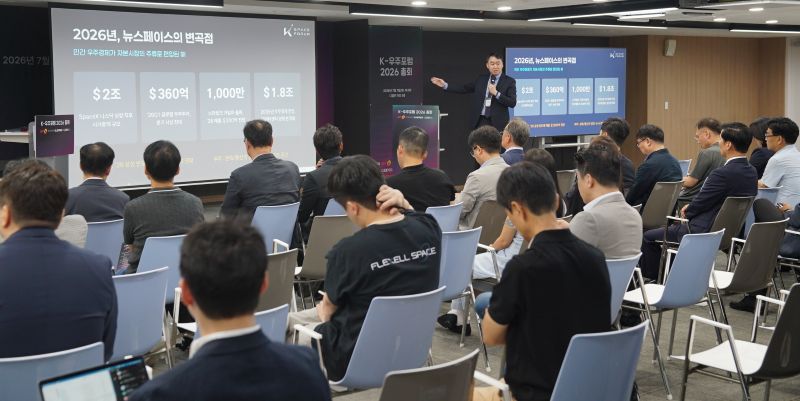
On July 7, the K-Space Forum convened its first official General Assembly at Front1 in Seoul, marking a significant step forward in building a private sector-led NewSpace ecosystem in South Korea.
Jointly operated by GDIN and MoneyToday’s startup media platform 'Unicorn Factory,' the assembly brought together over 100 space tech innovators, venture capitalists, academic pioneers, and defense officials. Since its first global conference in April, the forum has rapidly grown into a collaborative network of over 50 member organizations, bridging the gap between conglomerates, startups, and institutional investors.
🌐 Shifting Focus from Technical Autonomy to Market Self-Reliance
During the keynote address, Forum Chairman Prof. Bok Jik Lee of Seoul National University noted that while the global space economy is integrating into mainstream capital markets, South Korea's ecosystem faces structural challenges. Despite a KRW 1 trillion national aerospace R&D budget and an expanded KRW 200 billion NewSpace fund, nearly 75% of domestic aerospace development remains centered around state-run research institutes, leaving private enterprises with limited commercial market base.
"Contracts build industries, but connectivity builds the ecosystem," emphasized Prof. Lee. "To ensure public funding successfully translates into an industrial economy, we must move beyond mere technological self-reliance and actively pursue market self-reliance. The K-Space Forum will serve as a neutral connector and capital gateway to accelerate this transition."
📈 Driving Full Value Chain Integration and Global Expansion
To address these market gaps, the K-Space Forum announced a structured operational roadmap. The council plans to expand its industrial focus beyond launch vehicles to encompass the entire aerospace value chain—including satellite manufacturing, ground station infrastructure, data services, and components supply chains. To create immediate commercial pipelines, the forum will host quarterly private networking sessions, biannual startup-investor R&D matching sessions, and a flagship global forum at COEX this October.
GDIN will leverage its global networks to ensure these domestic space pioneers successfully scale internationally. "GDIN is fully committed to serving as a global bridge for South Korea’s frontier space tech innovators," stated Sokjin Chang, Managing Director of GDIN. "By providing structured cross-border validation programs and joint venture frameworks, we will support Korean space enterprises as they integrate into the global space economy."
|
|
|
🚀 FuriosaAI: The AI semiconductor pioneer is expanding into the European market through a strategic partnership with Equinix, a global digital infrastructure leader. FuriosaAI will deploy its proprietary AI inference accelerator, 'RNGD,' at Equinix’s Lisbon data center in Portugal. This milestone leverages Equinix’s expansive network of over 270 data centers across 33 countries to establish a powerful European commercial footprint.
|
|
|
🚀 Zenerate: The AI-driven proptech innovator secured an exclusive B2B SaaS service contract with Tenda, one of Brazil's top five construction corporations. Zenerate provides an advanced generative design platform that automates initial architectural mapping and feasibility studies. Tenda plans to deploy this AI framework to significantly accelerate its large-scale affordable residential and rental housing projects across Brazil. |
|
|
🚀 DEEPX: The ultra-low-power on-device AI semiconductor specialist entered a strategic partnership with Japan’s Koshida Corporation to accelerate its expansion into the Japanese market. DEEPX will supply its proprietary NPU product lineups alongside its comprehensive software development environment to support high-volume mass production for local clients, while Koshida leverages its extensive regional distribution networks to drive new project sourcing. |
|
|
🚀 Bigwave Robotics: The physical AI orchestration pioneer achieved over $450,000 in cumulative export orders within just six months of entering the U.S. market. The firm secured major contracts for global automotive assembly automation and advanced robotics research platforms. |
|
|
InterX: Leading the Next Frontier of Autonomous Manufacturing |
|
|
The global manufacturing sector is rapidly shifting from simple automation to autonomous manufacturing, where AI agents independently make real-time decisions amid unpredictable factory floor variables. While the industry demands data-driven autonomy, traditional smart factories remain bottlenecked by fragmented data siloes across isolated machinery and acute skilled labor shortages.
InterX, GDIN’s newly onboarded manufacturing AI partner, is addressing this friction with its advanced Gen.AI Server—an enterprise-grade architecture that transforms legacy infrastructure into self-learning autonomous environments.
🛰️ Layout-Aware 'Document.AI' and Precision Parsing via MixLoss
Traditional LLMs frequently trigger hallucinations or fail when processing complex, multi-page industrial documents due to their inability to read unstructured formatting. InterX eliminates this risk through its proprietary document intelligence value chain:
-
Layout-Aware Parsing: The 'Document.AI' engine processes technical drawings, metadata, and formulas into structured JSON formats with zero noise.
-
Complex Table Structuring via MixLoss: Utilizing its advanced MixLoss collaborative learning framework, InterX accurately extracts complex industrial tables, outperforming general-purpose engines by up to 7.7% in precision.
-
Domain-Adapted Foundation sLMs: Trained on a specialized library of over 50,000 professional manufacturing academic papers, InterX’s small language models (sLMs) possess deep expertise in welding, plastic injection molding, and electronics.
📊 Agentic Workflow: Real-Time Multi-Agent Orchestration
Moving beyond static monitoring, InterX's platform operates an intelligent multi-agent network that links perception directly to real-time process control:
-
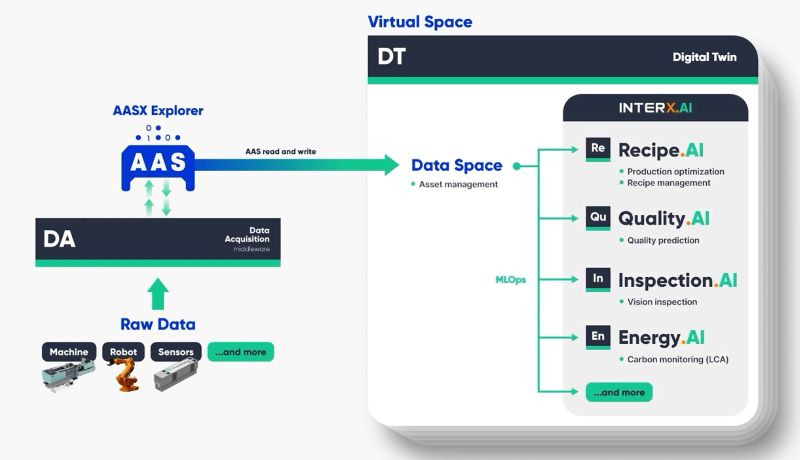
The Multi-Agent Ecosystem: A centralized coordination agent orchestrates task-specific sub-agents—such as Recipe.AI for process control, Quality.AI for defect prediction, and Safety.AI for hazard prevention—to enable autonomous cross-functional collaboration.
-
Advanced RAG with Multi-Representation Indexing: InterX integrates a secure internal knowledge base merging Vector DBs, Relational DBs (Text-to-SQL), and Graph DBs, delivering hallucination-free answers strictly grounded in enterprise private data.
-
Operational Optimization: By automating data collection and report generation, the platform slashes decision-making cycles and administrative task times by over 40% on average, significantly boosting overall floor productivity.
To ensure absolute data sovereignty, InterX supports comprehensive, 100% on-premises deployment with airtight user access controls. The commercial impact is well-proven, with over 100 industrial deployments including strategic national projects with market leaders like Samsung SDI and Posco DX. Backed by expanding global partnerships with giants like Sony Semiconductor Solutions and the Fraunhofer Institute, InterX is successfully establishing the international standard for software-defined autonomous manufacturing.
|
|
|
Decoding Korean Innovation |
|
|
South Korea Deploys 18 GovTech AI Projects to Transform Public Services |
|
|
South Korea is accelerating the integration of advanced artificial intelligence into the public sector to modernize state services and address complex social challenges. The Ministry of Science and ICT (MSIT) has officially launched the "2026 GovTech Startup AI Demonstration and Commercialization Support Program," selecting 18 high-impact projects. Operating on a demand-driven matching model, the initiative connects public institutions identifying administrative hurdles with tech startups capable of deploying practical AI solutions.
📊 Balanced Execution: 18 High-Impact Projects Across Three Core Pillars
To guarantee structured integration across public administrative levels, the 18 selected projects are categorized into three distinct operational frameworks, bridging public demand with private innovation:
-
Citizen-Centric Service Enhancement (7 Projects): Streamlining administrative tasks through advanced automation, featuring platforms such as automated AI review systems for public documentation (Korea AI Lab) and real-time AI evaluation systems for emergency care appropriateness (Dallgoo).
-
Regional & Social Issue Resolution (5 Projects): Utilizing deep-tech applications to improve urban living, including AI-powered traffic control systems to reduce intersection congestion (Green AI) and drone-linked AI platforms for agricultural monitoring (Turbine Crew).
-
Public Infrastructure Innovation (6 Projects): Deploying specialized AI models to safeguard national assets, including next-generation AI highway drainage design verification platforms (WeSmart) and advanced AI-based sewage pipeline defect inspection systems (TheBetter)
⚙️ Building Commercial References for Global Market Entry
Beyond updating public software, the program is structurally engineered to serve as an institutional reference-building pipeline for early-stage startups. Because entering sovereign procurement and international markets requires proven deployment records, the MSIT is supplying selected GovTech enterprises with comprehensive business model diagnostics, specialized consulting, and dedicated networking channels for global tech exhibitions. By positioning the government as a primary reference client, South Korea continues to establish a scalable validation model that transforms early-stage public sector deployments into sustainable, international commercial assets.
|
|
|
4F, Startup Campus Building #3, 20, Pangyo-ro 289Beon-gil, Bundang-gu, Seongnam-si, Gyeonggi-do Korea 13488
You are receiving this email because you have visited our site or asked us about regular newsletter.
|
|
|
|
|